
 +86-18158270618

0102030405
Custom Spray Nozzles for Private Label Brands: Thread, Flow Rate and Spray Pattern Options
2026-09-04

TL;DR
- Custom spray nozzle programs for private label buyers come down to three specification buckets: thread and connection type, flow rate and pressure window, and spray pattern geometry.
- Thread options cover NPT (North American), BSP (European/Asian), and metric (M5/M6) in sizes from 1/8 inch to 1 inch, with material choices from POM/PP plastic to brass and stainless steel.
- Flow rate is specified at a defined reference pressure (1.0 bar for micro-spray, 2.0 bar for landscape sprays, 3.0 bar for impact sprinklers) with pressure-compensating options for variable-pressure sites.
- Spray pattern options are full circle, adjustable part circle, strip pattern, mist, and jet, with the first three accounting for approximately 85% of private label volume.
- End-to-end custom nozzle program timelines run 8-14 weeks for new tooling and 4-6 weeks for repeat orders using existing tooling.
Private label spray nozzles are a different conversation than catalog nozzles. The catalog buyer wants a SKU at a price. The private label buyer wants a product that looks like theirs - on the shelf, on the box, on the spec sheet - and performs to a specification they can defend to their own customer. That means the conversation has to cover thread geometry, pressure behavior across the operating window, pattern consistency batch to batch, color match to the rest of the brand line, and packaging that survives international freight.
After working with private label buyers across North America, Europe, the Middle East, and Southeast Asia, the same handful of specification decisions come up on virtually every project. This guide walks through the three specification buckets that drive a custom nozzle program - thread and connection, flow rate and pressure behavior, spray pattern - and finishes with the workflow questions that determine whether your program ships on time.
For an overview of the full spray nozzle category range the catalog covers both adjustable and fixed-pattern options. If you want arc-adjustable bodies specifically, the adjustable spray nozzles product page shows the geometry in detail. The project inquiry form returns MOQ, tooling cost, and lead time within one business day.
The Three Specification Buckets That Drive Every Custom Nozzle Program
Every spray nozzle specification, whether for a residential pop-up, a commercial drip system, an agricultural impact sprinkler, or a greenhouse mist nozzle, decomposes into the same three buckets:
Bucket 1 - Thread and connection. How the nozzle physically attaches to the system. Wrong thread spec means the product does not fit the buyer's distribution piping and the order becomes a return.
Bucket 2 - Flow rate and pressure behavior. How much water the nozzle delivers, at what pressure, and how that delivery changes across the operating window. Wrong flow spec means poor irrigation uniformity in the field and a quality complaint from the end user.
Bucket 3 - Spray pattern geometry. What shape the water leaves the nozzle in - full circle, part circle, strip, mist, jet. Wrong pattern means the nozzle does not match the application and the buyer's distribution channel cannot sell it.
Get all three right and the program runs cleanly. Get any one wrong and the program becomes an inventory write-down. The rest of this guide walks through each bucket with the specification decisions a private label buyer needs to make.
Thread and Connection Options
Thread selection is the most underestimated specification in a private label program because it looks trivial on the spec sheet. The wrong thread spec means the product physically does not connect to the buyer's market distribution system, leaving the buyer with a shipment of unsellable inventory.
The Three Thread Standards You Will Encounter
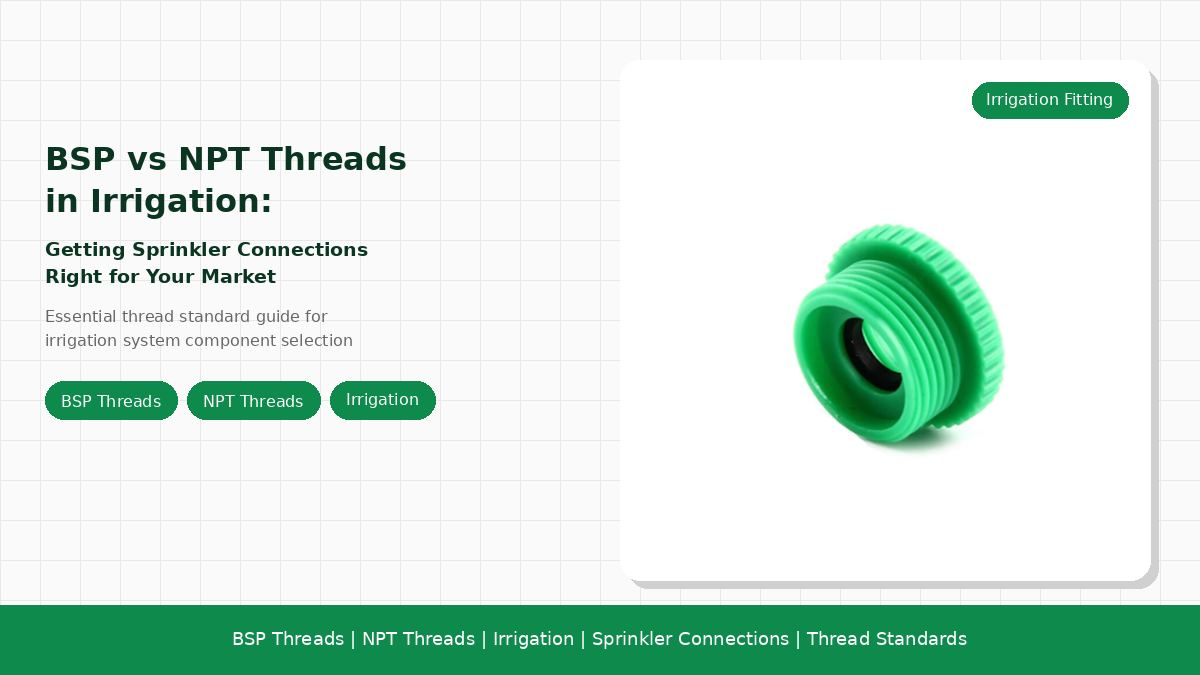
Spray nozzles for irrigation use three primary thread standards. The buyer's target market dictates which standard applies:
- NPT (National Pipe Thread, ANSI/ASME B1.20.1): Tapered thread used in North America and most of Latin America. The taper creates the seal through thread interference, so thread sealant or PTFE tape is required for a leak-free joint. Common sizes in nozzles: 1/8 inch, 1/4 inch, 3/8 inch, 1/2 inch, 3/4 inch, 1 inch.
- BSP (British Standard Pipe, ISO 228 and ISO 7): Used in Europe, most of Asia, the Middle East, Africa, and Australia. Available in two variants - BSPT (tapered, ISO 7) and BSPP (parallel, ISO 228). BSPP requires an O-ring or bonded seal washer for sealing. Common nozzle sizes: 1/8 inch, 1/4 inch, 3/8 inch, 1/2 inch, 3/4 inch, 1 inch.
- Metric threads (ISO 261, ISO 262): Used in some low-pressure micro-spray and mist applications, particularly in greenhouse and propagation equipment. Common sizes: M5 x 0.5, M6 x 0.75, M8 x 1.0.
The most common private label mistake is specifying NPT when the buyer needs BSP (or vice versa). These two standards are not interchangeable. A 1/2 inch NPT thread has 14 threads per inch; a 1/2 inch BSP thread has 14 threads per inch but a different pitch diameter and thread angle. A nozzle with the wrong thread will start to engage and then bind - it will not seal, and forcing it will damage both the nozzle and the receiving fitting.
Male vs Female Threads
Thread gender is the second specification decision. Female-threaded nozzles receive a male-threaded riser or stem. Male-threaded nozzles screw into a female-threaded body. For pop-up spray bodies in Landscape Irrigation, the male-threaded nozzle is the industry default because it threads directly into the riser stem. For impact sprinklers and agricultural applications, female-threaded nozzles are more common because they receive the male riser pipe directly.
For a private label program, the buyer's existing distribution system dictates the gender requirement - not the manufacturer's preference. If the buyer already sells pop-up bodies that take male-threaded nozzles, your custom nozzle must thread into those bodies, full stop.
Material Selection for Threaded Bodies
The threaded body material affects pressure rating, chemical compatibility, UV resistance, and unit cost. For wholesale private label runs, the common material matrix is:
| Material | Typical Pressure Rating | Common Use Cases |
|---|---|---|
| POM (Acetal) | Up to 4 bar | Residential fixed spray nozzles, landscape drip nozzles |
| PP (Polypropylene) | Up to 4 bar | Low-pressure micro-spray, agricultural spray stakes |
| Nylon (PA66) | Up to 6 bar | Pop-up spray nozzles, agricultural impact sprinklers |
| Brass | Up to 10 bar | Commercial spray nozzles, premium landscape products |
| Stainless steel (304/316) | Up to 16 bar | Industrial, chemical fertilizer, high-pressure applications |
For most residential and landscape irrigation private label runs, POM or nylon body with a POM or stainless steel internal deflector is the cost-effective default. Brass or stainless steel is specified only when the buyer has a documented requirement for higher pressure, chemical exposure, or premium retail positioning.
Flow Rate Customization
Flow rate is the specification that determines whether the nozzle does its job in the field. Specify it wrong and the buyer's Irrigation System delivers uneven water distribution, the crops or landscape suffer, and the buyer's customer files a complaint that traces back to the nozzle supplier.
Why Flow Rate Must Be Specified at a Defined Pressure
Flow rate for a spray nozzle is not a single number. It is a relationship between pressure and flow that varies with nozzle geometry. A simple nozzle specified for "2 GPM" without a pressure reference is meaningless - the same nozzle will deliver 1.4 GPM at 1.0 bar, 2.0 GPM at 2.0 bar, and 2.6 GPM at 3.0 bar.
The reference pressure used to specify flow rate depends on the irrigation system the nozzle is designed for:
- Drip and micro-spray: 1.0 bar (14.5 psi) reference pressure. Most common for low-volume landscape and agricultural drip systems.
- Pop-up spray bodies and shrub spray nozzles: 2.0 bar (29 psi) reference pressure. Standard for residential and commercial landscape.
- Rotary Nozzles and small impact sprinklers: 2.5-3.0 bar (36-44 psi) reference pressure. Standard for higher-flow landscape applications.
- Agricultural impact sprinklers: 3.0-4.0 bar (44-58 psi) reference pressure. Standard for field crop and large landscape.
For OEM private label runs, the buyer must specify the target reference pressure explicitly in the purchase order. If the buyer's target market is North American residential landscape at 30 psi, the reference is 2.0 bar. If the target is European agricultural at 2.5 bar, the reference is 2.5 bar. Mixing reference pressures between the same physical nozzle geometry is how flow rate disputes happen.
The Standard Flow Rate Catalog
For fixed-spray landscape nozzles, the standard flow rate range runs from approximately 0.5 GPM (1.9 L/min) to 4.0 GPM (15.1 L/min). For residential pop-up spray bodies, the most common fixed-spray flow rates are:
- 8Q (8-foot radius, quarter circle): 0.5 GPM at 30 psi
- 10Q: 1.0 GPM at 30 psi
- 12Q: 1.5 GPM at 30 psi
- 15Q: 2.5 GPM at 30 psi
- 15H (half circle): 2.5 GPM at 30 psi
- 15F (full circle): 2.5 GPM at 30 psi
These correspond to common throw radius categories (8 ft, 10 ft, 12 ft, 15 ft). For a private label program, you can specify any flow rate within this catalog range, or request a custom flow rate that targets a specific radius not covered by standard SKUs.
Pressure-Compensating vs Non-Compensating
Pressure-compensating (PC) nozzles maintain flow rate within a defined tolerance across a pressure window - typically 5% flow variation across 1.0-3.5 bar (15-50 psi). PC nozzles are more expensive than non-compensating equivalents but deliver measurably better irrigation uniformity on sites with elevation changes, long lateral runs, or variable inlet pressure.
For residential and small commercial private label programs, non-compensating fixed-spray nozzles are the cost-effective default. PC nozzles are specified when the buyer's customer base includes sites with documented pressure variability, or when the buyer's brand positioning is "premium uniformity" and the higher unit cost can be defended at retail.
Spray Pattern Options
Spray pattern is the specification that determines whether the nozzle physically fits the application. A nozzle that delivers perfect flow at perfect pressure is unsellable if the spray pattern is wrong for the buyer's target market.
The Five Pattern Categories
Spray nozzle patterns fall into five primary categories:
Full circle (360 degrees). Sprays in a complete circle from a central riser. Most common in agricultural impact sprinklers and large-radius landscape rotary nozzles.
Part circle adjustable (typically 0-360 or 0-180 degrees). Sprays over a defined arc that the installer adjusts. Most common pattern in residential landscape because most lawn areas are not full circles.
Strip pattern (rectangular). Sprays in a narrow rectangle, typically 4-6 feet wide and 15-30 feet long. Used for narrow lawn strips, parking lot medians, side-yard irrigation.
Mist or fog (very fine droplet). Atomizes water into 50-200 micron droplets for greenhouse humidity control, plant propagation, outdoor cooling, and dust suppression. Requires a pressurized water supply or pump system.
Jet or fountain (long-throw streams). Produces defined streams rather than a spray pattern. Used in decorative fountains, water features, and some agricultural applications.
Pattern Distribution Across Private Label Volume
The pattern distribution across a typical 12-month production run is roughly:
- Part circle adjustable: 50-55% of unit volume
- Full circle: 20-25% of unit volume
- Strip pattern: 10-15% of unit volume
- Mist and jet specialty: less than 10% combined
This distribution is not a marketing preference - it reflects the actual shape of irrigated areas in residential and commercial landscape. A typical residential lawn has 4-8 part-circle zones and 1-2 full-circle zones; strip zones are for side yards; mist is a separate product category.
Adjustable Pattern Mechanics
For part-circle adjustable nozzles, the arc adjustment mechanism has two common options:
- Click-stop ratchet mechanism: The arc is set by rotating the deflector or nozzle top to a defined stop position (typically every 15 or 30 degrees). Easy to adjust in the field, no tools required. Standard for residential pop-up spray bodies.
- Friction-fit deflector with infinite arc adjustment: The deflector rotates freely and is held in position by friction. Allows infinite arc adjustment (not just preset stops) but can drift out of adjustment under vibration or temperature cycling.
For private label runs targeting professional landscape installers, the click-stop ratchet mechanism is the standard request because it matches installer service kit expectations.
Private Label Customization Options Beyond the Three Buckets
Once the thread, flow rate, and pattern are specified, the private label customization layer adds the variables that make the product look and feel like the buyer's brand rather than the manufacturer's.
Color Customization
Body color is the most visible private label customization. Standard catalog colors are black, gray, and brown, but private label buyers frequently specify brand colors to match the rest of their product line. For an existing-tooling color change (using the manufacturer's standard mold), color MOQ is typically lower than for a fully new mold. The new color masterbatch is mixed into the production run and the part design stays the same.
Color stability under UV exposure and chlorinated water contact should be specified in the purchase order. UV-stable masterbatch rated for 3-5 years of direct sunlight exposure is the landscape standard.
Packaging and Labeling
Private label packaging typically includes bulk (bags or cartons with the buyer's part number), retail-ready (individual hangtag or blister pack per nozzle), or display-ready (counter display unit or shelf-ready tray for 12-50 nozzles). The buyer should specify packaging at the inquiry stage because decisions affect unit cost, MOQ, and lead time.
Tooling and Mold Ownership
For a fully custom nozzle program, the buyer typically has three tooling ownership options:
- Manufacturer-owned tooling: Lowest upfront cost, but the buyer cannot prevent the manufacturer from selling the same part to competitors.
- Buyer-owned tooling at the manufacturer's facility: The buyer controls the tool and can move it if needed.
- Buyer-owned tooling at the buyer's facility: Maximum control, but requires production scheduling coordination.
For most private label buyers, manufacturer-owned tooling with an exclusivity agreement is the cost-effective default. The exclusivity clause prevents the manufacturer from selling the same part to direct competitors during the contract term.
Quality Control and Certification
For a custom nozzle program, the buyer's quality control requirements typically fall into three categories:
Material Certification
The buyer should require a material certification document (MCD or mill cert) with each production run, confirming that the plastic, brass, or stainless steel grade matches the spec. For food-contact or potable-water applications, NSF/ANSI 61 certification is required. For landscape irrigation, the certification requirement is typically less stringent.
Performance Verification
Flow rate verification at the reference pressure should be performed on a sample basis per production batch. The standard is typically 5-10 nozzles per batch measured against the reference pressure on a calibrated test bench. The reference standard for irrigation nozzle performance testing is ISO 8026 (Agricultural irrigation equipment - Sprayers - General requirements and test methods). Spraying nozzle manufacturers following ISO 8026 testing protocols provide batch reports with mean flow rate, coefficient of variation, and pressure-flow curve.
Visual and Dimensional Inspection
For private label buyers, the visual consistency of the part across the production run is a critical quality criterion. Color match, surface finish consistency, and absence of visible mold defects should be specified in the QC standard. The ASABE standards (American Society of Agricultural and Biological Engineers) cover performance and labeling requirements for many nozzle categories in North America.
The Custom Nozzle Workflow: From Inquiry to Delivery
For buyers new to private label nozzle programs, the workflow below is what an OEM project manager will run from initial contact to first delivery:
Phase 1 - Specification (1-2 weeks). Buyer submits part specifications including thread, flow rate, pattern, material, and color. Manufacturer confirms feasibility, provides unit price, MOQ, and tooling cost. Buyer issues purchase order or sample request.
Phase 2 - Sampling (1-2 weeks). Manufacturer produces pre-production samples using existing tooling (for color change programs) or soft-tool samples (for new geometry). Buyer approves samples or requests modifications. Sample approval triggers production scheduling.
Phase 3 - Tooling or color setup (1-5 weeks). For new geometry programs, mold fabrication takes 3-5 weeks. For existing-tool color change programs, masterbatch preparation and machine setup takes 1-2 weeks.
Phase 4 - Production (2-4 weeks). Production run with in-process quality control. Buyer receives pre-shipment samples for final approval if requested.
Phase 5 - QC, packaging, and shipping (1-2 weeks). Final QC inspection, packaging, and international freight coordination. Documents include packing list, commercial invoice, material certificate, and any required certifications.
The total timeline from inquiry to first delivery is typically 8-14 weeks for new geometry programs and 4-6 weeks for repeat orders on existing tooling. The biggest variable is the new mold fabrication time, which can be compressed but rarely below 3 weeks for a steel injection mold.
Frequently Asked Questions
What thread types are available for custom spray nozzles?
The most common thread options for OEM spray nozzles are NPT (North American standard), BSP (European/Asian standard, available as BSPT tapered or BSPP parallel), and metric M5/M6 threads for low-pressure micro-spray applications. Thread size ranges from 1/8 inch to 1 inch for residential and landscape irrigation, with 1/2 inch and 3/4 inch being the most common for wholesale private label runs. Material selection for the threaded body typically includes POM, PP, nylon, brass, or stainless steel.
How do I specify flow rate for a custom spray nozzle?
Flow rate for a custom spray nozzle should be specified at a defined reference pressure - typically 1.0 bar for micro-spray, 2.0 bar for landscape pop-up sprays, or 3.0 bar for impact sprinklers. Standard residential fixed spray nozzles range from 0.5 GPM (1.9 L/min) to 4.0 GPM (15.1 L/min), with pressure-compensating versions maintaining flow within 5% across a defined pressure window.
What spray pattern options are available for OEM nozzles?
OEM spray nozzles are available in five primary pattern categories: full circle (360 degrees), part circle adjustable (typically 0-360 degrees or 0-180 degrees), strip pattern (rectangular coverage for narrow beds), mist/fog (very fine droplet size for propagation or cooling), and jet/fountain (long-throw streams). For landscape irrigation private label programs, full circle, part circle adjustable, and strip patterns account for approximately 85% of volume.
What is the minimum order quantity for a custom spray nozzle?
For a fully custom private label spray nozzle program with branded packaging, the typical MOQ is in the low-to-mid five figures depending on complexity. For an existing-tooling private label run - using the manufacturer's standard body and color, but with your brand on the label, hangtag, and packaging - MOQ is significantly lower and can sometimes be accommodated in the high three to low four figures. Always confirm MOQ, tooling cost, and lead time before placing the initial PO.
How long does a custom spray nozzle program take from inquiry to delivery?
The end-to-end timeline for a custom spray nozzle program is typically 8-14 weeks depending on complexity. For repeat orders using existing tooling, the timeline collapses to 4-6 weeks. The longest single phase is mold fabrication for new geometry programs, which typically requires 3-5 weeks even under compressed scheduling.
Closing Note From the Product Desk
A successful custom spray nozzle program is not the program with the lowest unit price. It is the program where the specification decisions match the buyer's actual market application. Specify NPT 1/2 inch at 1.5 GPM at 2.0 bar in part circle and you get a different product from NPT 1/2 inch at 1.5 GPM at 2.5 bar in strip - both differ from 1/2 inch without specifying NPT or BSP.
The investment in getting the specifications clear at the inquiry stage pays back many times - lower return rates, fewer warranty disputes, faster repeat orders, brand consistency buyers recognize on the shelf.
If you are evaluating a custom adjustable spray nozzle program or starting a broader private label project , the engineering team can review your specifications against your target market and recommend a configuration. Submit your target thread, flow rate, pattern, color, and packaging requirements via the project inquiry form and we will respond with a feasibility assessment within one business day.