
 +86-18158270618

0102030405
Cycle Life Testing for Pop-Up Sprinklers: How to Read a Manufacturer's Test Report
2026-10-30
TL;DR
- A sprinkler cycle life test report is a set of conditions, not a number, so the cycle count means nothing without the pressure, temperature, sample size and failure criteria behind it.
- One cycle is one full extension and retraction of the pop-up stem, so a report showing 100,000 cycles documents 100,000 on-off events on each tested unit.
- No sample size, no pressure range, no stated failure definition and no laboratory name means the document is marketing material.
- RAIN LING publishes its own conditions, including fatigue resistance evaluation, spray performance analysis and extreme temperature cycling from −30 °C to 60 °C.
- Read seven fields in order, score the report out of 20 points, and request model-level and batch-level reports before you sign.
A sprinkler cycle life test tells you how many times a pop-up spray body can extend and retract before a defined failure appears, and a manufacturer's report only becomes comparable when you read the conditions attached to that number. The number alone is decoration; the conditions are the data.
Procurement goes wrong here. One distributor quotes a cycle count, a second quotes a larger one, and the buyer assumes the bigger number wins. Because a cycle count is valid only inside the conditions that produced it, a larger count at 1.0 bar and 20 °C says nothing about 3.5 bar and 40 °C, so the two numbers are not in competition.
Below are the seven fields that make a report usable, the six failure modes a cycle test can predict, and a way to read a lab cycle count without turning it into a service-life promise. Our own figures come from our own pages: a 4,000+ m² Ningbo factory with 20 injection molding machines and an in-house laboratory at AQL 0.65.
What Is a Sprinkler Cycle Life Test?
A cycle life test repeatedly drives a pop-up spray body through its normal motion until a defined failure appears, and one cycle means one full extension to pop-up height followed by retraction into the body cap.
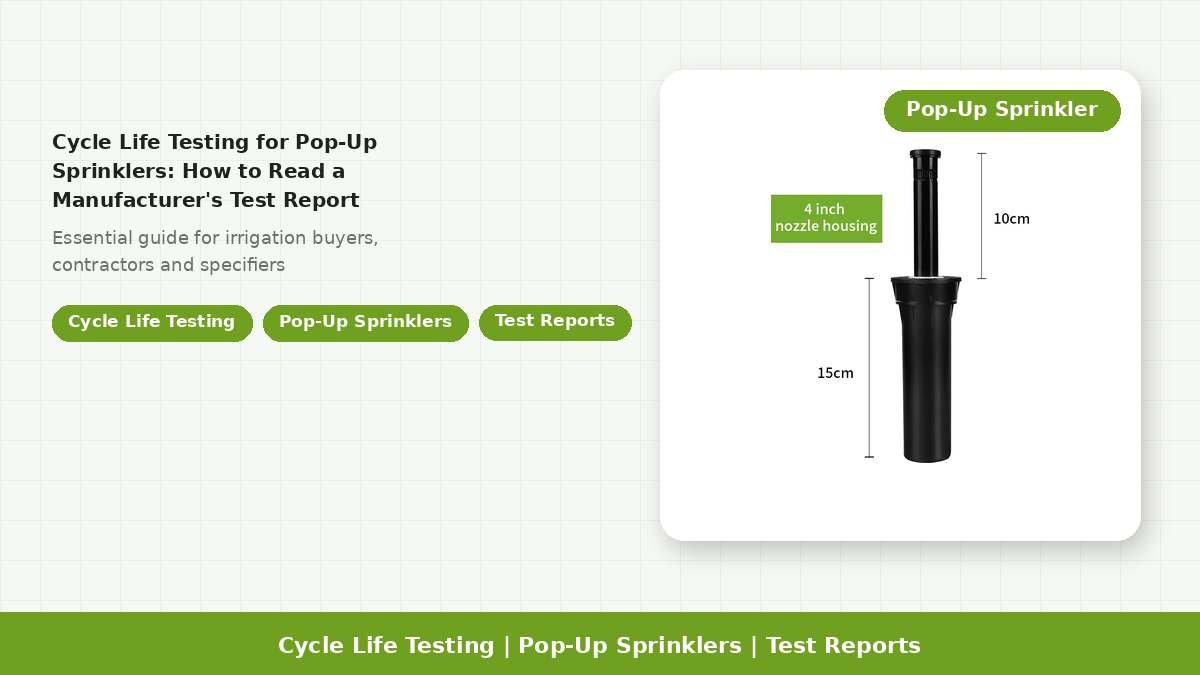
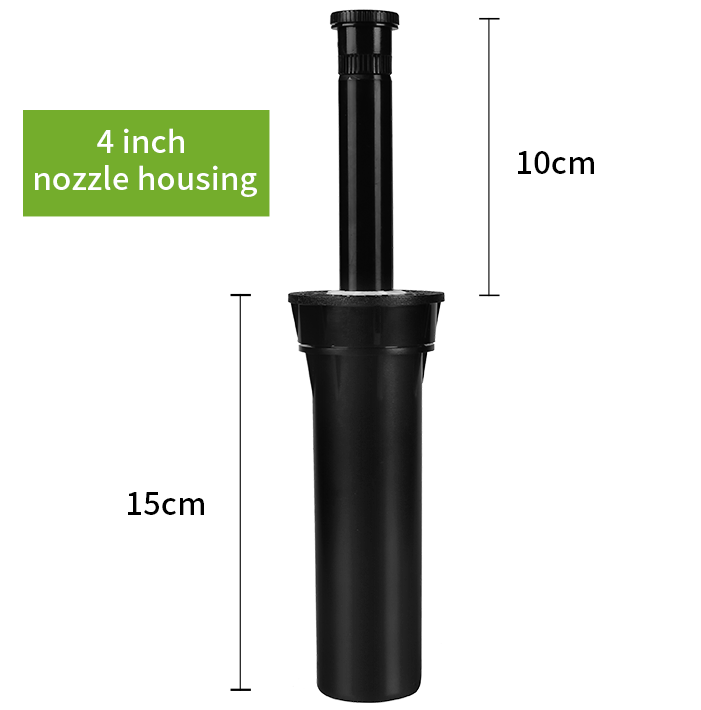
Every cycle loads the stem and its guide, the wiper seal, the return spring, the inlet seal and the thread pair, so a cycle count measures accumulated fatigue across those parts. On our 4-inch RL4 each cycle moves the stem 10 cm above the cap and back into a 15 cm body, and the RL4RS adds a check valve and pressure regulator, so it carries a criterion the standard body never has to meet.
Which Test Parameters Should You Check First?
The seven fields I use to judge a sprinkler cycle life test report are sample size, cycle count, operating pressure, flow rate, water temperature, failure criteria and laboratory identification.
We read them in this order:
- Specimen identity and sample size. How many bodies, which model and revision.
- Cycle count and cycles per day. The headline, and whether the rate imitated a schedule.
- Operating pressure in bar or psi. Held constant, or cycled.
- Flow rate in L/min and the Nozzle fitted. Whether the body was tested as it ships.
- Water temperature in °C. Seal and spring behaviour is temperature dependent.
- Failure criteria. Leak rate in mL/min, height deviation in mm, a stem that will not retract.
- Test date, laboratory and method. A dated, named report can be audited.
Score as you read: 2 points for each field present and quantified, 1 for a field present but qualitative, 0 for a missing field. 14 or more out of 20 can go into a specification, 7 to 13 means I request the missing conditions, and below 7 is marketing material.
Our own incoming inspection runs to AQL 0.65 inside an ISO 9001-certified system, the standard I expect from any supplier claiming durability. Review the commercial spray bodies we build, or jump to the model specification below.
How Do You Read a Test Report Line by Line?
The first thing I check is the report level: a model-level report tells you the design is sound, a batch-level report tells you this lot is sound, and a spot-check tells you almost nothing beyond the day it was taken.
Most reports I receive run in the same order:
- Scope and specimens. Model, revision, body count, first article or production lot.
- Test conditions. Bench setup, pressure, flow, temperature, duty cycle.
- Failure criteria. Measurable limits, stated before the results.
- Results and approval. Values at each interval, then who signed them, for which lot.
Our published RL4 specification is the reference point any endurance discussion sits next to, and the RL4 pop-up spray body specs are where you can check it:
| RL4 specification | Published value |
|---|---|
| Body height | 15 cm |
| Pop-up height | 10 cm |
| Inlet thread | 1/2" female |
| Materials | ABS, POM, rubber, 304 stainless steel |
| Versions | RL4, and RL4RS with check valve and pressure regulator |
| Warranty | 3 years |
| Made in | CE and ISO 9001 facility, Ningbo, China |
Note what that table omits: any cycle count. I treat a cycle count as a property of a test and not of a product, so a datasheet that mixes one in is describing its test bench.
How Do You Know a Test Is Credible?
The credible reports I trust come from a named laboratory that states its accreditation, its method and its sample size, while a PDF with a cycle count and a logo is a marketing sheet.
The competence standard I check a laboratory against is ISO/IEC 17025:2017, and accreditation matters because its scope tells you which tests it may perform. According to the International Laboratory Accreditation Cooperation, mutual recognition arrangements mean an accredited report in one country is accepted in the others, as described on the ILAC site.
- The method is named. A stated procedure can be repeated; "durability test" cannot.
- The sample size is stated. A conclusion from a few bodies is an observation, not a distribution.
- Failure is objectively measurable. Leak rate and height thresholds are auditable; "performed poorly" is not, and neither is a report whose raw data is missing.
I will be straight about my limit: I have never audited a laboratory I did not work with, so I give you a field list that makes any report auditable, not a certificate that it is good.
Two standards sit close to cycle testing. Salt fog testing under ASTM B117-19 runs in a 5% sodium chloride atmosphere at 35 ± 2 °C and answers a corrosion question a cycle test cannot. Cold exposure under IEC 60068-2-41 defines severities down to −40 °C, from 1 to 24 hours.
Which Failure Modes Does a Cycle Test Actually Predict?
I have seen a cycle test predict six failure modes that matter in the field, and nothing about the way a body is installed or abused.
| Failure mode | What the report should record | What it looks like on site |
|---|---|---|
| Wiper seal and O-ring fatigue | Leak rate, mL/min | The zone weeps and water pools. |
| Stem guide wear | Height deviation, mm | The spray arc sits low and coverage thins. |
| Return spring fatigue | Retraction and force | The head stays up, or pops out. |
| Thread and inlet wear | Torque retention, joint leakage | The head rocks and the zone loses pressure. |
| Anti-drain check valve failure | Drain-down volume per cycle | Water drains from the low point after the pump stops. |
| Nozzle and body wear | Pattern uniformity at test end | The spray turns misty, distribution uneven. |
The last row is the one buyers forget: a body can survive every cycle and still mist by the end, because uniform coverage is a functional property, not a durability one. A specification written only in terms of leakage would pass a body that had stopped distributing water, so the failure criteria must include spray pattern and height.
Here is the honest boundary: a cycle test does not predict sand abrasion, mower damage, chemical attack, or a zone run with a failed valve.
How Do You Convert Lab Cycles Into Field Expectations?
Convert a cycle count into a field expectation by counting the cycles your zone runs in a year, then treat the ratio as context and not as a service life, as I do. A daily zone runs about 365 cycles, a three-times-a-week zone about 156, a twice-a-week zone about 104, and a weekly zone about 52.
Take an illustrative case: a report stating 100,000 completed cycles at 3.5 bar and 40 °C, read against a zone running three times a week, gives about 640 years of operation. That number is absurd, so a lab cycle count is not a service life, and a raw count tells a buyer nothing without the zone's schedule.
- Soil and traffic. Sand and traffic wear the stem guide and wiper seal faster than a bench.
- Water chemistry. Chlorine and fertilizer attack rubber seals and stainless parts, so ask for corrosion data.
- Climate. Freeze and thaw work on body and seals in ways a constant-temperature bench never sees; our own testing covers cycling from −30 °C to 60 °C.
When a project has to document water efficiency, I point buyers to EPA WaterSense, the criteria North American buyers are asked to meet.
Do not convert a lab cycle count into a service-life promise, because the cycle count describes a bench condition and not a soil, a climate or a watering schedule.
How Do You Compare Two Manufacturers' Reports?
I compare two reports only when the pressure, the water temperature, the duty ratio and the failure definition match, and when they do not the correct conclusion is that the reports are not comparable.
| Field to check | Why it decides the comparison |
|---|---|
| Sample size | More bodies give a distribution, not an observation. |
| Cycle count | Meaningless until matched with the conditions. |
| Operating pressure | A count at lower pressure is not the higher-pressure duty. |
| Water temperature | Seals and springs behave differently when hot. |
| Failure criteria | Counts against different criteria cannot be compared. |
| Laboratory and scope | Scope decides evidence versus opinion. |
Two rules I would not bend. Compare the failure criteria before the cycle counts, because a strict criterion at a lower count says more than a large count against a loose definition. Treat report level as part of the comparison.
What Should You Ask a Manufacturer Before You Order?
When I review a supplier's evidence I ask for the model-level endurance report, the batch-level report for the lot you are buying, the failure-mode data behind the pass or fail, and the laboratory name, because a supplier who answers all four has nothing left to hide.
- Model-level endurance report for the exact model and revision, with sample size and method.
- Batch-level report for your lot. We supply batch test reports on request, and a verified lot beats a design verified once.
- Failure-mode data: what failed, on how many units, at which cycle count.
- Laboratory name and accreditation scope, so somebody else can check it.
- Warranty terms and exclusions. Our RL4 family carries 3 years, and the exclusions show what the maker is confident about.
- Certification for your market: CE and RoHS for the EU, SASO and ESMA for the Gulf, WaterMark and AS/NZS for Australia and New Zealand, UL or NSF where potable-water parts are involved.
A good answer names the laboratory, the method, the sample size and the failure definition, and it offers the batch report. A bad answer is a cycle count with no conditions attached to it.
You can request batch test reports for the model and lot you are evaluating, and our team will come back with the model-level document, the batch document and the failure-mode data. Mr. Fan can be reached on +86-18158270618 or sales@rainlingirrigation.com, or at No. 11, Xingchuang Road, Luojiang Industrial Park, Yuyao City, Ningbo, China.
Frequently Asked Questions
What does a sprinkler cycle life test actually measure?
A sprinkler cycle life test measures how a pop-up spray body behaves over repeated extension and retraction until a defined failure appears. One cycle is one full movement from pop-up height back into the body, and the test measures the fatigue life of the moving parts.
How many cycles should a pop-up sprinkler report show for a commercial project?
There is no universal number, because a cycle count is comparable only inside the conditions that produced it. Count your own schedule instead: about 365 cycles a year for a daily zone, 156 for three runs a week, 52 for one.
Does a higher cycle count mean a better sprinkler, and can I compare two suppliers directly?
No, because a higher count under lighter conditions or a looser failure definition says less than a lower count under demanding conditions. Read sample size first, then failure criteria, then conditions, and the cycle count last. Two reports are comparable only when pressure, water temperature, duty ratio and failure definition match.
What does pop-up sprinkler durability testing prove, and what does it not prove?
It proves how the unit behaved over a defined number of cycles at a defined pressure, flow rate and temperature, and it exposes fatigue in the stem guide, seals, spring, inlet and check valve if those are the criteria. It proves nothing about abrasion, traffic or chemical attack.
What should a batch test report contain before I accept a shipment?
Ask for the lot identifier, test date, model and revision, sample size, cycle count, pressure and flow rate, water temperature, failure criteria, laboratory name and the result per unit. If a field is missing, the shipment is not verified in a way you can audit.
Where the Decision Belongs
A cycle count is a condition set and not a quality score, and the quality of a supplier's evidence shows up in the fields they are willing to publish. Our commercial spray bodies show the discipline on our side: 20 injection molding machines feeding 4 automated assembly lines, an in-house laboratory running fatigue resistance evaluation, spray performance analysis and extreme temperature cycling from −30 °C to 60 °C, and incoming inspection at AQL 0.65. Send the model, the zone conditions and the failure definition that matter in your project, and we will quote the endurance evidence that matches them.