
 +86-18158270618

A trial order is not a smaller bulk order. It is a sampling plan with a written acceptance rule, and the rule has to exist before the samples arrive, not after the shipment has landed and someone is looking for a reason to keep it. This protocol sets out five gates a distributor can run on a sample batch, the measurable criterion at each one, and the record that makes the decision defensible months later.
Quick answer
- Decide the pass criterion before the sample ships. A trial order without a written acceptance rule is a purchase, and the rule you end up applying will suit the samples you received.
- Run five gates in a fixed order. Identity, spray pattern, flow accuracy across the pressure range, material durability, then field fit. Each gate can stop the order, so a failure is cheap to find early.
- Test the whole pressure band, not one pressure.Published tables run from 1.5 bar to 3.5 bar. A Nozzle that hits its number at 2.0 bar and misses at 3.5 bar will not behave as specified on a real zone.
- Measure against published figures, not impression. Strip nozzles are specified from 1.2 × 5.0 m to 2.7 × 5.5 m and adjustable nozzles across six radius options from N6 to N17. Date, pressure, batch, operator, readings and photographs turn a judgement call into an auditable decision.
- Keep the records. Date, pressure, batch, readings and photographs turn a judgement call into an auditable decision.
Distributors buying irrigation equipment for the first time usually treat a trial order as a discount. It is not. It is the only point where you can hold goods against a written specification before money is committed at scale, and that is worth a day.
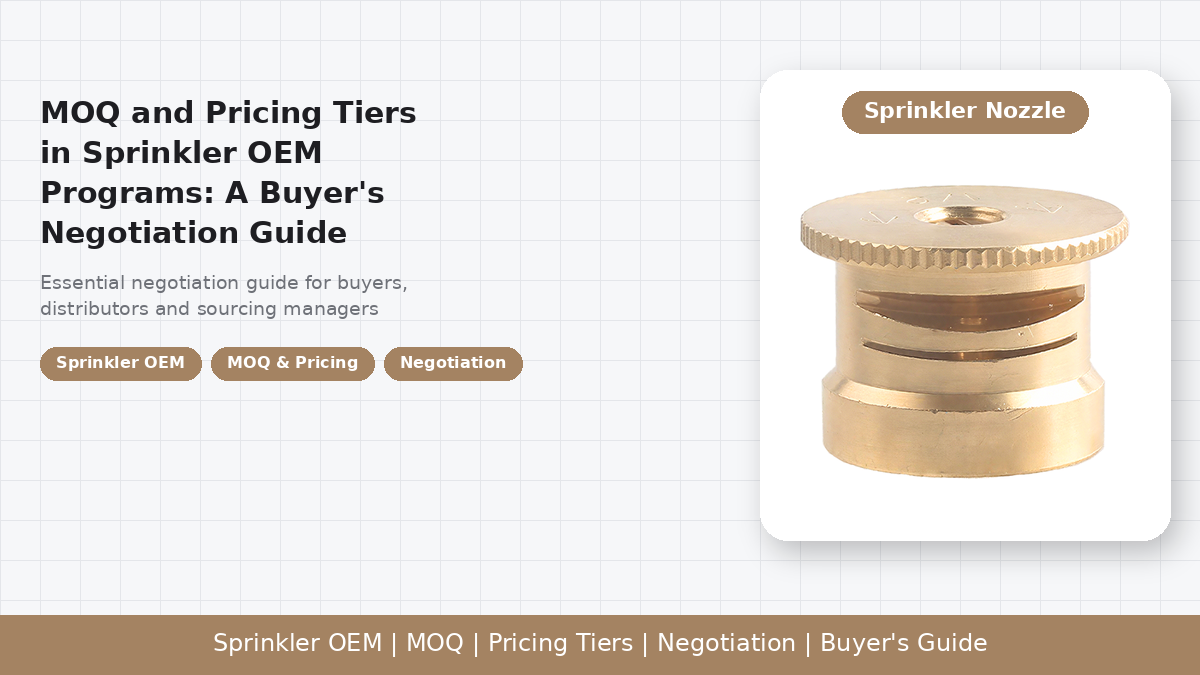
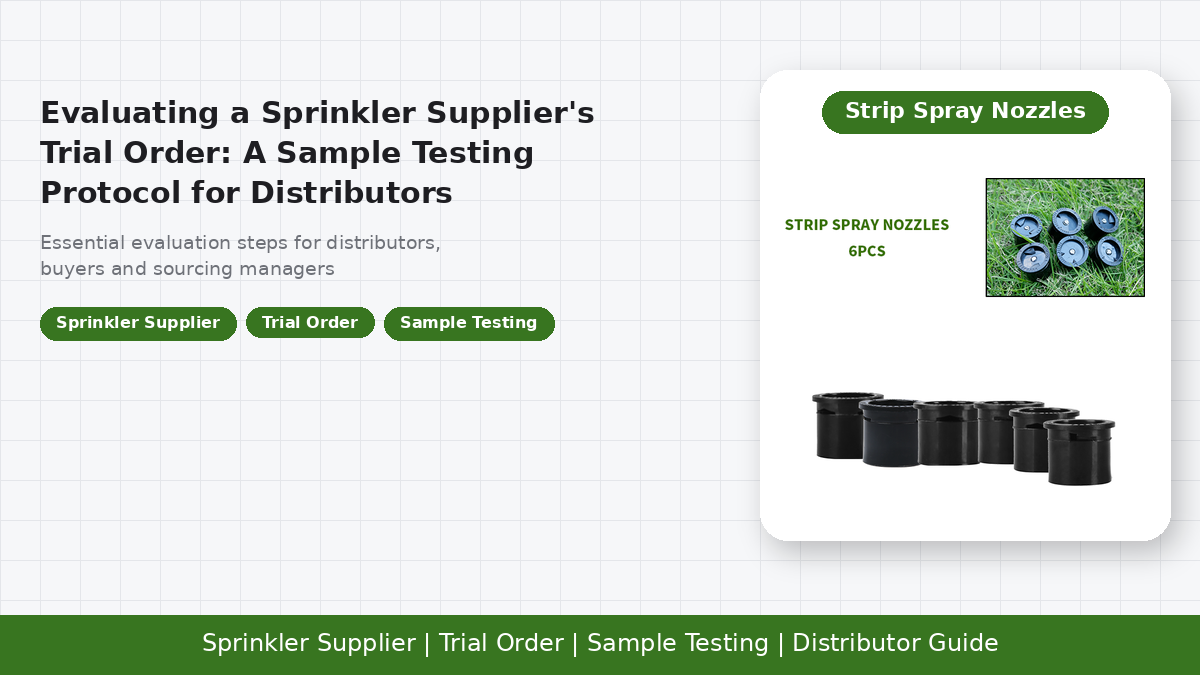
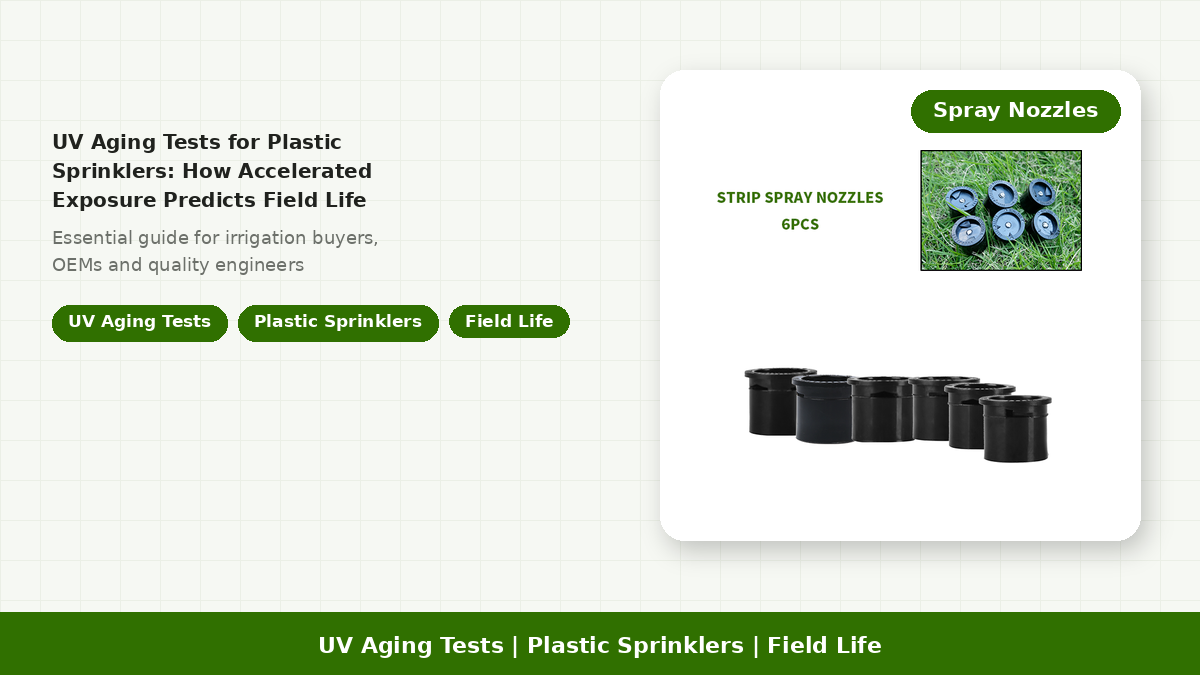
The products that make this concrete are small enough to test on a bench and specific enough to test without a lab. Our spray nozzle range covers adjustable nozzles, strip nozzles, brass nozzles and full-circle bubblers, each with published flow and radius figures against pressure. Our strip spray nozzles are the clearest case: high-strength POM bodies producing rectangular distribution from 1.2 × 5.0 m to 2.7 × 5.5 m, with universal thread compatibility, a 3-year warranty and CE and ISO 9001 certification.
What a Trial Order Is Actually For
The purpose of a trial order is to convert an assumption into a record. A distributor's real question is rarely "is this nozzle good?" It is whether the units will do what the catalogue claims, in the pressures and water conditions of the destination market, before a container is booked and stock sits where it cannot be returned.
That framing changes the design of the test. One designed to get a discount ends with a subjective impression. One designed to produce a record ends with readings that either match a published figure or do not, and the decision follows from that rather than the buyer's mood on the day the carton opened.
It also changes what you ask for when the order is placed. The production setup matters: a self-owned plant running 20 injection moulding machines, 4 automated assembly lines and an in-house quality laboratory, working to ISO 9001 processes and AQL 0.65 inspection standards, tells you a repeat order will resemble the sample.
Gate 1: Does the Sample Match the Specification?
Everything downstream depends on the sample being what it claims to be, so identity comes first and it comes cheaply. Record the model designation against the purchase order, the batch or production marking, and the certification on the product or its packaging. Our adjustable and strip nozzle families are CE and ISO 9001 certified with a 3-year warranty, and that trail is part of what you are buying, not paperwork to file later.
Then check the two specifications most often substituted without anyone noticing: thread compatibility and the material. Adjustable and strip nozzles are both specified as universally compatible with major pop-up spray bodies, and both moulded in high-grade POM for wear, chemical and UV resistance. A sample that will not thread into a standard body, or that is a different polymer by touch or marking, has already failed.
Record each unit you sample rather than sampling the batch once. If you have taken twenty pieces, test five and record all five by position, because a supplier shipping a mixed batch is unlikely to admit it.
Gate 2: Does the Spray Pattern Hold Its Shape?
Pattern is the first gate that can fail on a perfectly good-looking product. For an adjustable nozzle the specification is fine control of arc from a full 360° down to a single degree, with a wind-resistant edge that keeps pattern integrity and distribution uniformity in a breeze. For a strip nozzle it is rectangular distribution sized to the zone, from 1.2 × 5.0 m to 2.7 × 5.5 m, with overspray eliminated.

Test both in the open, on level ground at the intended spacing, and photograph each configuration. For an adjustable nozzle, walk the arc from 90° through 180° and 270° to 360° and check the cut-off edge stays crisp rather than feathering out. For a strip nozzle, confirm the watered band matches the dimension ordered and the edges do not throw onto the adjacent path. Eliminating overspray is the whole reason a strip nozzle costs more than a plain one.
Pattern behaviour in wind separates a good nozzle from a catalogue rendering. Our adjustable nozzle has a wind-resistant edge because a pattern that breaks up in a breeze wastes water and leaves dry patches at the arc end. If your trial market has regular wind, test on a windy day.
Gate 3: Does the Flow Rate Match the Published Curve?
This is the gate that catches the substitution, and where most trial orders should spend their time. Published performance is given as flow in m³/h and radius in metres at five pressure points:
| Pressure | 1.5 bar | 2.0 bar | 2.5 bar | 3.0 bar | 3.5 bar |
|---|---|---|---|---|---|
| Flow (m³/h) | 0.19 | 0.23 | 0.26 | 0.30 | 0.32 |
| Radius (m) | 8.4–1.2 | 9.4–1.5 | 10–1.5 | 10–1.6 | 10–1.6 |
The pattern is the same across the range. Pressure raises flow and extends radius, so the published figures let you predict zone behaviour at any working pressure. Adjustable nozzles follow the same structure, with N6 covering roughly 1.5–2.1 m and N17 reaching 4.7–5.5 m depending on pressure and arc. If your market writes irrigation work to a published standard, the national standards catalogue maintained by ASABE identifies which performance figures you are expected to quote.
Measure flow into a graduated container over a fixed interval at each pressure, and compare against the published column for that exact model and arc. Note the regulator pressure at the nozzle, not at the supply, because a long lateral line costs pressure between the valve and the head. A sample that reads on the money at 2.0 bar but runs low at 3.5 bar is not a rounding difference; it is different internal geometry, and it misbehaves in exactly the zones where overspray becomes a complaint.
Gate 4: Does the Material Survive Your Conditions?
Material is where a trial order earns its keep, because the failure mode is invisible until it is expensive. Our adjustable and strip nozzles are moulded in high-grade POM, with published advantages in resistance to wear, harsh chemicals and UV degradation. Three checks follow, and all are cheap.
First, chemical compatibility: place a sample in the fertiliser or cleaning agent your customers actually use, at working concentration, and leave it. Second, UV exposure: nozzles above ground see far more sun than one in a sprinkler body, and the failure is a dulling and then a brittle rim. Third, thermal cycling: our quality regime subjects product to cycling between −30°C and 60°C, so a sample that has not seen it is not representative.
Where a market is coastal, salt spray is the test that matters. The standard method is set out in ASTM B117, the salt spray fog apparatus practice, and for distributor-side screening the practical version is to hold samples in a salt solution at working concentration and inspect the threads and adjustment collar at fixed intervals, because salt attack shows up first at the sealing surfaces.
Gate 5: Does It Fit and Function in the Field?
The final gate is the only one your customer will see, and it catches what bench testing cannot. Install a few trial units in a live zone alongside a nozzle you trust, run the zone through its normal cycle, and observe. The questions are narrow: does the nozzle seat fully and lock, does it retract and seal without weeping at the end of the cycle, does the arc hold its setting after a week, and is the pattern identical on the second run.
Check the one failure a new sample hides well: weeping after the cycle stops. A nozzle that does not seal at the riser shows up as a wet spot that persists after the pump cuts, and on a strip zone it wets the path edge rather than the planted strip. Run it long enough for the system to depressurise, because a slow bleed and a failed seal look identical in the first minute.
Also check the adjustment collar holds under real use. On an adjustable nozzle the setting is what the installer changes in the field, and a collar that drifts after a week turns your specified arc into an unspecified one. Write the setting on the record sheet so a complaint can be compared against it.
The Records That Make a Trial Order Defensible
A protocol without records is an opinion with extra steps. For each gate keep the same fields: date, tester, model, batch, pressure, reading, photograph reference and pass or fail. Two or three hours produces a document that answers three questions months later without argument: what was tested, measured and accepted.
Record the batch the sample came from, because that links the trial to the order that follows. Record the published figure alongside your reading, so the comparison is visible rather than reconstructed. Record the pass or fail against the criterion you set in advance, not the reading you wish you had.
One further step is worth the effort: tell the supplier the result. A supplier that receives a specific, measured, protocol-based pass or fail learns what you will check, and the next conversation starts from a shared method rather than a dispute.
One caution about scope. Testing cannot certify the product. Certification for the European market runs through the CE conformity route and the declaration of conformity, and a test report only carries weight if the laboratory behind it is accredited by a body such as ILAC. A trial order generates evidence for a commercial decision; it does not replace a conformity assessment.
Frequently Asked Questions
How many samples should a distributor request in a trial order?
Enough to test across the spread rather than to fill a box. Our production and quality setup works to AQL 0.65 inspection standards, so goods are inspected on a sampling basis rather than unit by unit. A batch spanning several production runs and cartons gives a realistic view of the variation you will receive, and five units from different positions beats six from one.
What pressure should I test spray nozzles at?
Across the full published range rather than at a single point. Our flow and radius tables are given at 1.5, 2.0, 2.5, 3.0 and 3.5 bar, and testing only the middle of that band hides the failures that matter most: a nozzle that reads correctly at 2.0 bar but runs low at 3.5 bar produces a bad zone. Measure at the nozzle, not the supply.
How do I test a strip spray nozzle for distribution accuracy?
Lay the nozzles out at their intended spacing on level ground, run them, and measure the watered band rather than estimating it visually. The strip range is specified from 1.2 × 5.0 m to 2.7 × 5.5 m, so the criterion is whether the wetted rectangle matches the dimension ordered, with no overspray on the long edges. That edge condition is the reason to choose a strip nozzle at all, so it is both the first thing to check and the first thing to reject a sample over.
Can a trial order replace certification for my market?
No, and it is worth being clear with your customer. A trial order is commercial evidence: it tells you whether the goods match a published specification in your own conditions. Certification is separate, running through the CE conformity route and the declaration of conformity, with laboratory accreditation handled through bodies such as ILAC. Use the trial to reduce risk on the goods and the conformity documentation for access.
What should I ask the supplier before the sample ships?
Ask for the batch or production reference so the sample ties to a run, the certification trail for the model, and the published figures for the exact model and arc you intend to buy. Ask whether the samples come from current production, because a sample from an older run tells you about a specification you may no longer receive. Then set your acceptance criteria in writing.
How long should I keep the records from a trial order?
Keep them for at least the warranty period you negotiated, and as long as you buy from that supplier. Our adjustable and strip nozzles carry a 3-year warranty, so a record set supporting the acceptance decision should outlive the warranty on the units it describes. The value shows when a later claim needs checking: with test date, pressure and readings on file, a warranty discussion becomes a comparison rather than an argument.
Published 4 November 2026 · Last verified 4 November 2026 · Material, flow and radius figures, pressure bands, warranty terms and certification scope verified against the RAIN LING spray nozzles category, Strip spray nozzles category and adjustable spray nozzle product pages on 4 November 2026. This article is procurement and quality guidance only, not a substitute for the product data sheet, the installation manual or a formal conformity assessment. Published figures must be confirmed against current product data before ordering, and any acceptance decision remains the buyer's own.