
 +86-18158270618

A pop-up sprinkler fails in three ways before its body or Nozzle wears out: water leaks around the riser when the system is off, the riser sticks in the up position and gets mowed, or the riser never pops up at all in the next irrigation cycle. Each of these failure modes traces back to a different small component inside the spray body — the wiper seal, the O-ring on the riser stem, and the retraction spring respectively. None of the three parts is visible from outside the unit. All three are replaced only when the spray body is disassembled, which most landscape maintenance plans never do. That combination is what makes the small parts the deciding factor in the 5-year service life of any 2-inch pop-up spray body, including the Rain Ling RL2 spray body that this article uses as the engineering reference.
This piece is written for irrigation distributors and brand sourcing teams who need a component-level QA vocabulary before they commit to a private-label program or a multi-container OEM order. The QA vocabulary is not visible on the box; it is visible on the production floor and on the bench at the incoming-inspection station. The article walks through the three failure modes, the small part responsible for each, the material specification and dimensional check that catches a short-life part, and how RAIN LING's component-level QC at the Yuyao facility (founded in 2020, operating a 4000 sqm factory with 20 injection molding machines and 4 automated assembly lines) maps to those checks.
How a Pop-Up Spray Body Actually Works
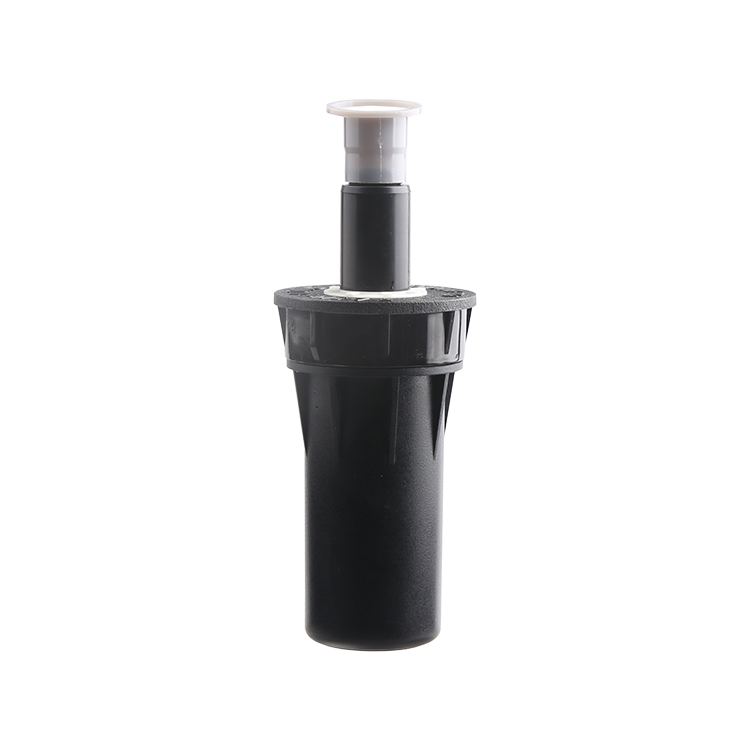
The 2-inch pop-up spray body is a small hydraulic actuator. When the irrigation valve upstream opens, water pressure enters the body through the female inlet thread, pressurizes the chamber under the riser, and pushes the riser upward against the retraction spring. When the valve closes, the pressure drops and the spring pulls the riser back down into the body. The riser carries the nozzle at its top, so pop-up and retraction are the two motions that deliver water to the lawn and then hide the nozzle below grade between cycles. The mechanical life of this actuator is set by the wear and fatigue of the parts that move against each other every cycle: the riser stem rubbing through the wiper seal, the O-ring being compressed and decompressed against the inside wall of the riser shaft, and the spring being compressed and released once per irrigation cycle.
The Rain Ling RL2 runs the standard 5 cm pop-up travel on its standard body, with the same 5 cm travel exposed on the matching RL4, RL6, and RL12 family members, so the component wear rates below apply to the full spray body product line. The spring, the seal, and the O-ring carry the same engineering specification across the family because they live in the same riser shaft geometry. Buyers sourcing multiple pop-up heights from one factory do not need to re-qualify the small parts from one SKU to the next.
The Three Field Failure Modes
The Irrigation Association's landscape irrigation best practices resource groups pop-up spray body service complaints into three clusters. The same three clusters show up in Rain Ling's warranty-decline analysis at the Yuyao facility and in the field reports from the European and Australian distributor network since the company started exporting in 2024.
Failure Mode 1 — Leak Around the Riser When the System Is Off
The most common complaint. The spray body looks dry at the surface, but water continues to seep from the riser perimeter long after the valve closes, leaving a damp ring or a small puddle at the base. The cause is almost always the wiper seal that rides on the outside diameter of the riser. When the seal hardens, cracks, or loses its lip interference, water bypasses it on every pressure cycle. In a residential zone that runs twice a day, that is 700 plus pressure cycles per year on the seal lip, which is enough to expose any material weakness inside 18 to 36 months.
Failure Mode 2 — Riser Stuck in the Up Position
The second most common complaint. The riser pops up on the first cycle of the morning, then fails to retract when the valve closes. The owner finds a 2-inch-tall plastic stub sticking out of the lawn and either mows it off or breaks it with a foot. The root cause is split. About half the cases trace to the retraction spring, which has lost enough free length that its uncompressed force is no longer enough to overcome the static friction of the riser seal against the shaft wall. The other half trace to debris — typically fine sand or turf thatch — packed into the wiper seal groove, which jams the riser in the up position. The two failure paths produce similar field symptoms but require different procurement interventions.
Failure Mode 3 — Riser Fails to Pop Up
The third and most operationally disruptive complaint. The valve opens, the controller logs the station as active, but no spray pattern appears at the head. The cause is a retraction spring that has lost so much free length that its compressed force is no longer enough to push the riser up against the supply pressure, or a broken spring coil that leaves the riser mechanically disconnected from the spring seat. Less commonly, the cause is a seized pivot or a stripped riser stem thread, both of which fall outside the small-parts scope but should be checked when the spring and seal have been ruled out.
Engineering Detail — The Wiper Seal on the Riser Stem
The wiper seal is the part of the spray body that gets attention from landscape maintenance crews the least and from procurement engineers the most. It sits in a groove at the top of the riser shaft and wipes the riser stem clean on every pop-up and retraction cycle. It also acts as the primary barrier against debris migration down into the spring chamber. The wiper seal material, geometry, and lip interference are what separate a 2-year service life from a 5-year service life.
Material Selection
The Rain Ling RL2 wiper seal is nitrile rubber (NBR), chosen for the combination of low-temperature flexibility, abrasion resistance, and cost. NBR keeps an elastic modulus that allows the lip to maintain its interference fit at temperatures down to roughly -10°C, which covers most temperate-climate winter installations; for colder climates, an EPDM or HNBR upgrade is the procurement conversation. The ASTM D2240 standard test method for rubber hardness is the bench reference that buyers can use to verify the seal compound delivered against the seal compound quoted. A 70 to 75 Shore A reading on a wiper seal of this size is the working range; readings above 80 Shore A indicate a stiffer compound that will lose lip interference faster in cold weather, and readings below 65 Shore A indicate a softer compound that will wear faster under sand abrasion.
Geometry and Lip Interference
The seal cross-section is a single-lip wiper design with a nominal 1.5 mm cross-section and a 12 mm inner diameter matched to the riser stem. The lip interference is set at 0.4 to 0.6 mm radial compression at room temperature, which is the geometric input that produces the wipe contact pressure on the stem. Too little interference and the seal leaks past dry; too much interference and the seal drag loads the spring, which shortens the retraction cycle count before the spring loses its free-length budget.
Incoming Inspection Check
The bench check that catches a short-life seal at incoming inspection is a simple Shore-A durometer reading on three sample units per lot, taken at three points on the seal cross-section. A reading outside the 70 to 75 Shore A band is a reject trigger regardless of the supplier certificate. The second check is a visual under 10x magnification for mold flash, parting-line burrs, or air pockets in the lip geometry; any of these three defects accelerates the wear that produces the leak-around-the-riser failure mode.
Engineering Detail — The O-Ring on the Riser Stem
The O-ring lives in a separate groove below the wiper seal and provides the static seal that stops water from leaking down into the spring chamber when the system is pressurized. The O-ring does not move on the riser stem (the riser moves through it), so its wear mechanism is different from the wiper seal. The O-ring fails by compression set, by chemical attack from the water chemistry, and by extrusion through the clearance gap if the groove geometry is wrong.
Material Selection
The RL2 O-ring is Buna-N (NBR) at a 50 to 60 Shore A hardness, which is softer than the wiper seal because the O-ring's job is a static compression seal rather than a dynamic wipe. A softer O-ring takes a longer time to reach its compression-set limit, which is the metric that determines the static-seal service life. The EPA WaterSense program documentation on water-efficient irrigation products references low-emission seal performance as part of the broader water-loss reduction framework, and the O-ring compound is one of the components that contributes to a WaterSense-aligned spray body.
Engineering Detail — The Retraction Spring
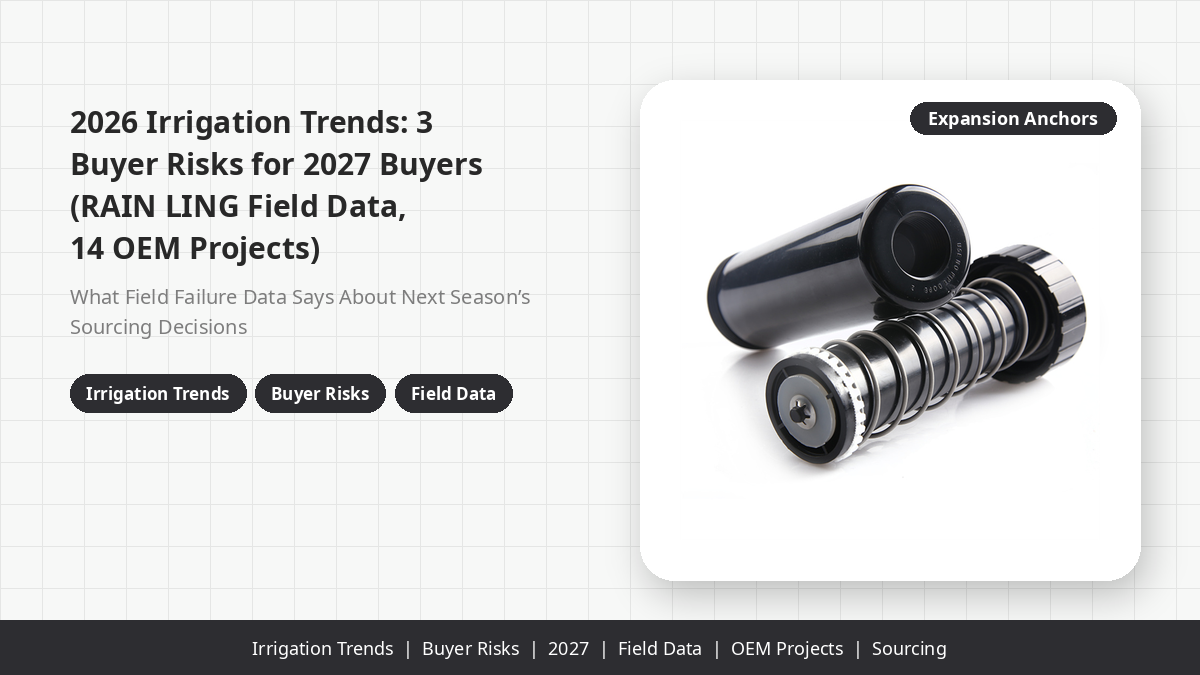
The retraction spring is the small part that fails least often but causes the most operationally disruptive failure mode when it does fail. The spring is a stainless-steel coil spring that sits inside the riser shaft, with its uncompressed end seated against the body cap and its compressed end seated against the riser seat. When the valve closes, the spring pushes the riser back down into the body.
Material Selection
The Rain Ling RL2 retraction spring is a 304 stainless-steel coil spring that sits inside the riser shaft, with its uncompressed end seated against the body cap and its compressed end seated against the riser seat. When the valve closes, the spring retracts the riser back down into the body. The RL2 spray body specification lists 304 stainless steel as one of the four primary materials in the assembly, paired with the ABS body, POM internals, and rubber seal compounds.
Material Selection
304 stainless steel gives the corrosion resistance needed for a part that lives in permanent contact with irrigation water. The wire diameter, coil count, free length, and load-at-deflection are the four engineering inputs that determine the service life. The Rain Ling specification targets a free length that holds within 2 mm through 5 years of typical residential service, which corresponds to a fatigue life well above the 50,000-cycle threshold typical of a daily-twice irrigation program over the same period.
Why Component-Level QC Matters More Than Body-Level QC
Most OEM suppliers operate a body-level QC system that checks the spray body for visual defects, dimensional conformance, and functional pop-up on the finished assembly. That QC system catches the body-level defects that account for perhaps 30 percent of field returns. The remaining 70 percent — the seal, O-ring, and spring failures described above — sit one level below the body-level QC layer, in the incoming small-parts inspection that runs when the wiper seals, the O-rings, and the springs arrive at the assembly line as separate part numbers.
Buyers who want to verify the component-level QC at a prospective OEM supplier should ask for three concrete data points, and can request the Rain Ling published inspection standards for the published AQL, fatigue, and temperature-cycling protocol. Buyers evaluating multiple Rain Ling product families on a single procurement decision can also reference the matching RL5200S rotor sprinkler specification and the Rain Ling news page on small-parts wear to confirm that the same component-level QA philosophy extends across the gear-driven rotor line and that the warranty-side conversation is documented publicly:
The seal Shore-A inspection record on the most recent production lot, showing the actual durometer readings on at least three samples.
2. The spring free-length and load-at-deflection record on the most recent production lot, showing the actual measurements on at least three samples.
3. The pull-and-leak test record on the assembled riser, run at 1.5 times the rated working pressure, on a documented sampling plan.
The Rain Ling QC system operates to ISO 9001-certified manufacturing processes with AQL 0.65 inspection standards, which is tighter than the AQL 1.0 to 2.5 typical of many OEM suppliers. The Yuyao facility adds fatigue resistance evaluations, precision spray performance analysis, and extreme temperature cycling tests in the -30°C to 60°C range, which together cover the small-parts wear mechanisms that drive the three field failure modes above.
Mapping the Failure Modes to the Rain Ling QC Tests
The Rain Ling QC test plan at the Yuyao facility maps directly to the three failure modes. The seal Shore-A inspection catches the seal-hardening mechanism that produces the leak-around-the-riser mode. The spring free-length and load-at-deflection inspection catches the spring-fatigue mechanism that produces the stuck-in-the-up-position mode. The pull-and-leak test on the assembled riser catches the integrated seal-and-O-ring leakage that produces a slow water-loss mode that does not show up in any single-part test.
The -30°C to 60°C temperature cycling test is the bench equivalent of a four-season field year compressed into a 48-hour test cycle. The test exposes the seal and the O-ring to the temperature extremes that drive the compression-set and the low-temperature embrittlement mechanisms, and it exposes the spring to the thermal cycling that drives the fatigue mechanism. A spray body that passes this cycle at incoming inspection is the closest a bench test can get to predicting the 5-year field service life.
Procurement Verification — What to Ask Your OEM Supplier
The procurement-side conversation with an OEM supplier is more useful when the buyer's QA team knows which questions to ask. Three questions are the highest-yield for a pop-up spray body sourcing decision.
Question 1 — What is the wiper seal material and Shore-A specification? A supplier that answers with a specific compound and a specific hardness range has a seal specification in place; a supplier that answers with "nitrile" or "rubber" without a hardness range is running without an incoming-inspection check on the seal.
Question 2 — What is the spring material and free-length tolerance? A supplier that answers with 304 stainless steel and a 1 mm free-length tolerance on a spring of this size has a spring specification in place; a supplier that answers with "stainless steel" or "spring steel" without a tolerance is running without an incoming-inspection check on the spring.
Question 3 — What is the assembled riser leak-test pressure and acceptance threshold? A supplier that answers with a specific pressure (typically 1.5 times the rated working pressure) and a specific leak rate threshold has a leak-test specification in place; a supplier that answers with "we test for leaks" without numbers is running without a documented leak-test acceptance criterion.
The answers to these three questions are also the answers that determine whether the buyer can hold the supplier accountable under warranty. A warranty claim on a leak-around-the-riser failure mode is supportable when the supplier has a documented Shore-A specification; the same claim is not supportable when the supplier has no seal specification on file.
What Distributors Should Look For on a Sample Evaluation
The first time a distributor evaluates a sample spray body, the bench check that catches the most common short-life indicators is the pop-up feel. A new spray body that is hard to compress by hand is a spring that is too stiff; a spray body that pops up with a sluggish feel is a spring that has already lost free length or a seal that is dragging too hard. Neither feeling is conclusive on its own, but both flag a sample that warrants a more detailed incoming-inspection conversation before the buyer places a production order.
The second bench check is a soak test. Submerge the sample spray body in water for 24 hours, then operate it through 50 pop-up cycles at the rated working pressure. A sample that leaks past the riser seal at any point in those 50 cycles has a seal or O-ring that will fail in the field within 12 to 24 months. A sample that pops up reliably through the 50 cycles and retracts cleanly has the component combination that drives the 5-year service life.
Buyers who want to put both bench checks into a procurement specification can request the Rain Ling sample evaluation protocol from the merchandising team via the Rain Ling contact page, which is the protocol Rain Ling applies to distributor sample evaluations on incoming sample shipments.
How the Small Parts Fit the Broader Spray Body Product Family
The RL2 is the 2-inch pop-up body in the Rain Ling spray body family, which also includes the 4-inch RL4, the 6-inch RL6, and the 12-inch RL12. All four bodies share the same riser geometry, the same seal and O-ring groove, and the same retraction spring specification, which is why a buyer who qualifies the RL2 components at incoming inspection has effectively qualified the components for the RL4, RL6, and RL12 as well. The 5 cm pop-up height of the RL2 is the only difference in component wear rate across the family, because the wear on the wiper seal is proportional to the cycle count, not per the pop-up travel distance.
The matched geometry is also why the same small-parts supply chain can serve the full family. Buyers sourcing multiple pop-up heights from one factory consolidate the small-parts inventory, the small-parts incoming inspection, and the small-parts warranty exposure on the same component specification. The cost savings show up in the procurement-side ordering cost rather than in the unit piece price, but the warranty-side savings show up as a lower small-parts failure rate across the full product family. Buyers building a multi-product catalog can reference the matching pop-up spray bodies and the Rain Ling rotor sprinkler line to consolidate the small-parts QC conversation on a single platform.
When to Walk Away From a Sample
A sample evaluation that produces any of the three failure-mode symptoms — leak after a 24-hour soak, sluggish retraction, or inconsistent pop-up force across three sample units — is a sample evaluation that should trigger a specification conversation with the supplier rather than a production order. The conversation should cover the seal Shore-A specification, the spring free-length specification, and the leak-test acceptance criterion. A supplier that engages with the conversation on those three points has a QC system that supports a 5-year service life. A supplier that answers the conversation with "all our spray bodies work fine" is running without the component-level QA vocabulary that the buyer needs.
The Irrigation Association's landscape irrigation best practices resource covers the maintenance and replacement side of the same problem from the landscape contractor's perspective, and the procurement-side protocol above is the factory-side mirror of the same component-level conversation.
Component-Level QC as a Sourcing Decision
The three failure modes, the three small parts, and the three QC checks add up to a sourcing decision framework that distinguishes a spray body that will serve a residential landscape reliably for 5 years from one that will fail in 18 to 36 months. The framework is independent of the spray body's brand, color, or retail packaging, which is why a distributor who applies the framework to a prospective supplier sample will arrive at the same conclusion that Rain Ling's warranty data has produced internally.
The framework is also independent of the unit piece price. A spray body with a modest unit-price premium that ships with a documented seal specification, a documented spring specification, and a documented leak-test acceptance criterion costs less over a 5-year service life than a spray body with a lower unit price that ships without any of those three specifications. The total cost calculation includes the warranty exposure, the field service call rate, and the brand reputation cost of a field failure, which are the costs the unit piece price does not capture.
Buyers who want to apply the framework to a Rain Ling OEM sample can request the sample evaluation protocol from the merchandising team via the Rain Ling contact page, and can review the broader Rain Ling spray body product line for the SKU mix that fits their distribution territory. Distributors building a broader catalog across the spray body and rotor family can pair the QC framework above with the procurement conversation on the matching RL5200S rotor sprinkler, which carries the same component-level QA philosophy into the gear-driven product line.
The framework is not a guarantee against field failure, but it is the procurement-side decision that gives the buyer the highest probability of avoiding the three field failure modes for the 5-year service life that the EPA WaterSense program documentation considers the typical Residential Irrigation product replacement cycle.
Frequently Asked Questions
What is the most common field failure mode on a 2-inch pop-up spray body?
Leak around the riser when the system is off, which traces to the wiper seal on the riser stem. The seal lip loses its interference fit through compression set, abrasion, or chemical attack, and water bypasses the seal on every pressure cycle. In a residential zone running twice a day, the failure typically shows up at 18 to 36 months.
How long does a typical pop-up spray body spring last in residential service?
A 304 stainless-steel spring in a typical residential irrigation program running twice per day accumulates roughly 3,600 cycles per year. A well-specified spring has a fatigue life above 50,000 cycles, which translates to 12 to 14 years of theoretical service life. The practical service life is usually set by corrosion or by loss of free length rather than by fatigue fracture.
What Shore-A hardness should a wiper seal on a pop-up spray body have?
70 to 75 Shore A is the working range for a nitrile wiper seal on a 2-inch pop-up spray body. Readings above 80 Shore A indicate a stiffer compound that loses lip interference faster in cold weather; readings below 65 Shore A indicate a softer compound that wears faster under sand abrasion. Bench-verify with a Shore-A durometer on three samples per lot.
Can a stuck-in-the-up-position spray body be fixed without replacement?
Sometimes. The two causes are spring fatigue and debris-packed seal groove. The debris cause can be cleared by pulling the riser, wiping the seal groove, and re-installing; the spring cause requires either a spring replacement (which is not a field-repairable operation on most spray bodies) or a full body replacement. Distinguishing the two causes requires pulling the riser and inspecting the spring free length against the original specification.
What is the standard leak-test pressure for an assembled pop-up spray body?
1.5 times the rated working pressure is the standard incoming-inspection pressure. For a residential spray body rated at 2.5 bar working pressure, the leak test runs at 3.75 bar. A supplier that documents this leak test on a sampling plan has a leak-test specification in place; a supplier that does not document the leak test is running without an acceptance criterion on the integrated seal-and-O-ring leakage rate.
Does the RL2 spray body use the same seal and spring as the RL4, RL6, and RL12?
Yes. All four Rain Ling spray body models share the same riser geometry, the same wiper seal, the same O-ring, and the same retraction spring. Buyers who qualify the small parts at incoming inspection on one model have effectively qualified them across the full product family.