
 +86-18158270618

TL;DR — Key Takeaways
- A white-label Irrigation Controller programme runs through seven branding tiers. They run from a printed label and manual only, through a coloured bezel insert, a printed front fascia, a two-tone enclosure colour and a moulded custom faceplate, up to a custom enclosure with branded electronics and a rebranded app.
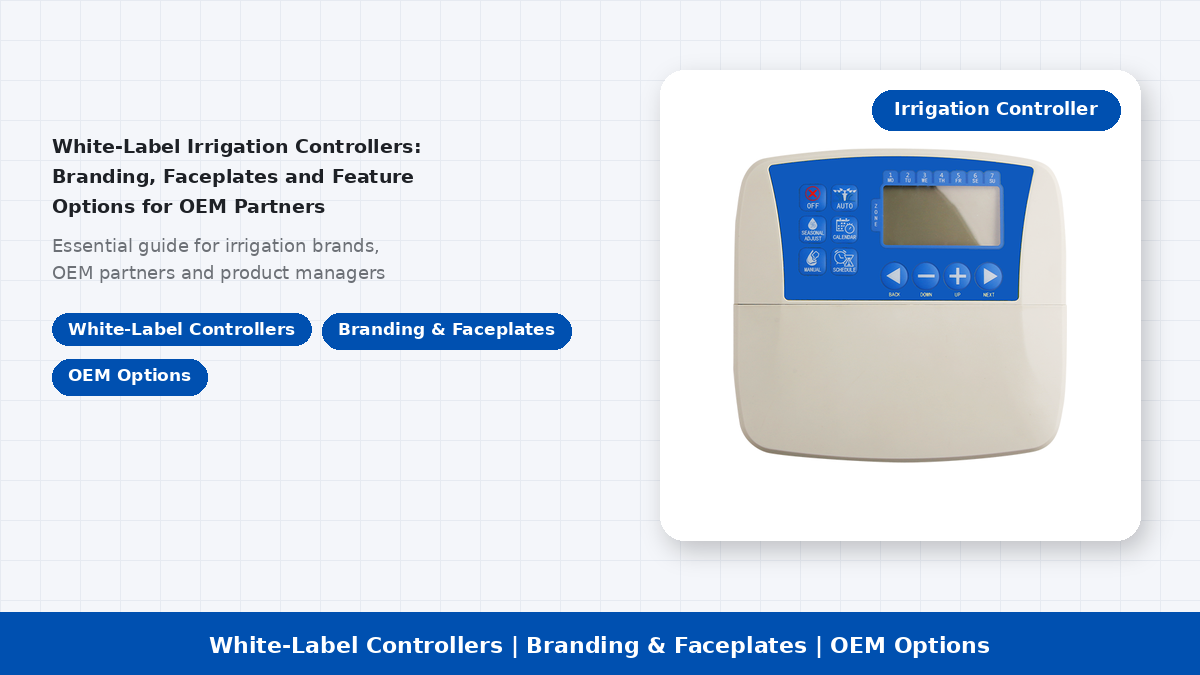
- The base platform is the 8-station RL-CA08 controller. It runs on AC 220V 50Hz input with AC 24V 1A output, measures 161 x 152 x 36 mm, offers three irrigation interval modes and up to six start times per zone, and ships 20 pieces per carton.
- Branding tiers 1 to 4 need no new tooling, and tiers 5 to 7 need a new mould. That distinction drives most of the cost and lead-time difference between a cheap private label and a genuinely own-brand product.
- Feature options change the certification scope, not just the price. A radio-equipped controller sold in the United States needs FCC equipment authorisation under 47 CFR Part 15, on top of CE marking for the EU.
- Lock the station count, the power input type and the enclosure protection class before any artwork is drawn. Changing any of them after the faceplate is approved means new tooling and a fresh certification cycle.
A white-label irrigation controller programme has seven branding tiers, and the choice between them determines your tooling cost, lead time and certification scope before it determines anything about how the product looks. The tiers run from a printed label and manual, through a coloured bezel insert, a printed front fascia and a two-tone enclosure colour, up to a moulded custom faceplate, a custom enclosure with branded electronics, and a full platform rebrand with a rebranded app and app store listing.
I work on the product side, so this is written from what happens in a factory rather than from a brochure. The most expensive mistake in a white-label programme is deciding the branding after the hardware is fixed, because the faceplate is drawn around the hardware, and changing the station count, the power input type or the enclosure protection class afterwards means a new mould and a fresh certification cycle.
Here is how the tiers work, what each changes, and which points to lock first.
What Are the Seven Branding Tiers?
The seven tiers differ in how many layers of the product carry your brand, and each additional layer costs tooling, lead time or both. Our controllers range lists three platforms — the Decoder Controller, the 8-Station Irrigation Controller and the modular station controllers — and each can enter a private label programme at any tier.
| Tier | What carries your brand | New tooling | Relative lead time |
|---|---|---|---|
| 1 | OEM label, manual and carton | None | Shortest |
| 2 | Coloured bezel insert | Insert only | Short |
| 3 | Printed front fascia | None | Short |
| 4 | Two-tone enclosure colour | Colour tooling | Medium |
| 5 | Moulded custom faceplate | Faceplate mould | Long |
| 6 | Custom enclosure, branded PCB | Enclosure, electronics | Longest |
| 7 | Platform rebrand with own app | Software, enclosure | Longest |
The distinction that matters commercially is between tiers 1 to 4 and tiers 5 to 7. Tiers 1 to 4 are a labelling exercise on hardware that already exists: the electronics, firmware, moulds and test regime are unchanged, so the certification you hold stays valid and you can move up a tier without redoing the compliance work. Tiers 5 to 7 mean new physical parts, and new parts mean new samples, new first-article inspection and usually a new test report. Start at tier 1 or tier 3 and reserve the right to move up once your channel tells you which features matter, because a private label controller is judged on the shelf on how it looks, what it costs and whether the specification covers the job.

What Can You Actually Change on the Faceplate?
On a tier 3 printed fascia you can change the graphics, the logo, the language set, the zone labels and the printed quick-start text, but not the geometry. The geometry is fixed by the mould: the LCD window, the rotary encoder position, the indicator window and the mounting hole pattern sit where the existing mould puts them.
At tier 5 you own the geometry too: you can change the faceplate proportions, add your logo as moulded-in relief, change the button and dial layout, and specify your own materials and finish. The trade-off is that you accept responsibility for every dimension on the faceplate, and the enclosure must be re-engineered around it.
A third option sits between tiers 3 and 5 and is under-used: the coloured bezel insert at tier 2, a thin moulded frame that clips over the standard faceplate and changes the perceived colour and finish without touching the electronics or mould. Because the insert is a separate part, one base controller can ship in several brand colours from the same run, which matters when a hardware store wants two or three colourways from one order.

Which Feature Options Actually Change the Product?
Five feature families move beyond cosmetic changes, and each changes the bill of materials, the test plan and sometimes the certification scope. This is where a tier 1 project quietly becomes a tier 6 project if nobody writes the feature list down first.
- Power source. The base RL-CA08 runs on AC 220V 50Hz input with AC 24V 1A output for the solenoid valves. A DC variant exists as the CD08 model, which removes the mains supply and changes the enclosure and certification.
- Station count. The base platform carries 8 stations. Adding stations is not a label change, because the board, terminal block and transformer change, and the faceplate must grow with it.
- Radio and connectivity. Adding Wi-Fi or a proprietary wireless link turns a wired controller into a radio product, a different regulatory conversation covered below.
- Sensor inputs. Soil moisture, rain, flow and lightning protection inputs are optional additions to the board, and each adds a terminal, a wiring instruction and a manual section.
- Enclosure protection. The base unit is an indoor-rated ABS enclosure. A permanently mounted outdoor position requires an IP-rated enclosure and a double-door design, as used on the Decoder Controller.
How Does the Feature Set Change the Certification Scope?
Certification follows the market and the radio, not the brand on the enclosure, and this is where white-label programmes most often go wrong. A brand change is not a regulatory event; adding a radio is.
For the European Union, a controller sold under your brand still needs CE marking. According to Directive 2014/35/EU on the Low Voltage Directive, the mains-powered model falls under the low voltage regime, and the same product also sits under Directive 2014/30/EU on electromagnetic compatibility and Directive 2011/65/EU on the restriction of hazardous substances. Those reports are issued against the product, so they carry across a branding change at tiers 1 to 4.
Add a radio module and the scope widens. Under 47 CFR Part 15 Subpart C on intentional radiators, a controller with a Wi-Fi or proprietary radio sold in the United States needs FCC equipment authorisation, and in Europe the equivalent is the radio equipment regime under Directive 2014/53/EU. That is a separate submission from CE marking, it tests radiated emissions rather than just immunity, and it is usually the longest item in the schedule. Third-party marks work the same way: our factory works to ASABE national standards, and bodies such as TÜV Rheinland issue the marks some channels require. All are decided on the product configuration, so they must be fixed before the test specimen is built.
Which Specification Points Must Be Locked Before Artwork?
Three points lock the hardware, and everything else hangs off them: the station count, the power input type and the enclosure protection class. Freeze those and the faceplate can be drawn; change any one later and it must be redrawn, which is the practical definition of new tooling.
Beyond those three, the specification that matters most is the scheduling behaviour, because that is what the end user experiences. The base platform gives three irrigation interval modes — weekly, odd and even day, and interval — with up to six start times per zone, and a seasonal adjustment that raises or lowers the watering duration across all zones to match weather conditions. Those numbers are written into the manual and onto the fascia, so change them and the artwork changes with them.
The mechanical baseline is equally fixed. The 8-station controller measures 161 mm in length, 152 mm in width and 36 mm in height, packed 20 pieces to a carton of 45 x 33 x 38 cm. For a partner replacing an existing product, those dimensions come first, because a controller that does not fit the existing DIN rail or cut-out will not sell however good the programme is.

What Does Quality Control Look Like on a Branded Build?
A white-label build is inspected to the same standard as a branded one, and the branding adds a layer of checks rather than removing one. Our manufacturing runs on ISO 9001-certified processes at AQL 0.65, and every product goes through fatigue resistance evaluation, precision spray performance analysis and extreme temperature cycling from -30 degrees Celsius to 60 degrees Celsius. What changes is the traceability of the cosmetic elements: a branded controller adds label, fascia artwork, colour swatch, carton print and manual content checks. The most common rejection in a white-label shipment is not a functional failure but a colour mismatch against an unapproved sample, because the standard was agreed verbally and never signed.
The fix is unglamorous and it works: approve a physical golden sample and compare against it. Our pilot practice seals one unit from the approved pilot run and compares the first mass production units against it for fit, finish, labelling and function, so a drifting mould or a wrong pigment batch is caught on day one. Brand changes also shift who carries the compliance paperwork, because the partner becomes the party named on the declaration of conformity and needs the technical file, the test reports and a traceable manufacturing arrangement they can produce at audit time, plus the spare part list, the manual and artwork files.
Where to Start Your Own White-Label Programme
The fastest route into a real quote is to start from a platform and a tier, not from a logo. Send the station count, the power input type, the destination markets, the target tier, the annual quantity and the packaging format, and you get a tooling cost, lead time and certification scope against a specific configuration. The 8-station irrigation controller product page carries the full base specification, and for larger commercial and agricultural programmes the Decoder Controller is the platform to discuss.
When you are ready to scope the commercial side, the contact page is where white-label programmes start. Our factory runs 20 injection moulding machines and 4 automated assembly lines across a 4,000 square metre facility with a dedicated in-house quality control laboratory, and since 2024 we have supplied distributors, retailers and irrigation brands across Europe, North America, Australia and beyond. Bring a specification and a target tier, and I will tell you which tier is worth doing and which only looks worth it.
Frequently Asked Questions About White-Label Irrigation Controllers
Does changing my brand name require new certification testing?
No, provided the product configuration does not change. The test reports and the EU declaration of conformity are issued against the product, not against the name on the enclosure, so a label, fascia or bezel change carries across at tiers 1 to 3. Change the station count, the power input type, the radio module or the enclosure protection class and you are back into testing.
What is the minimum order quantity for a white-label irrigation controller?
The base 8-station platform ships 20 pieces per carton. The practical minimum depends on the branding tier: tiers 1 to 3 change only the label, fascia or bezel insert and run at the smallest mixed-carton quantities the platform supports, while tiers 5 to 7 carry a mould charge amortised across the order, so the minimum rises with the tooling. Send the tier and the annual volume and you get a firm quantity and price.
Do I need to open new tooling for a private label irrigation controller?
No, not for most programmes. Tiers 1 through 4 work on the existing moulds, because a printed label, a printed fascia, a coloured bezel insert and a two-tone enclosure colour are changes made to a product that already exists. New tooling is needed only from tier 5 upward, where you own the moulded faceplate, and from tier 6 upward, where the enclosure is yours. The practical test is whether the faceplate geometry changes, since the LCD window, encoder position and mounting pattern are fixed by the mould.
Can I sell a rebranded controller in the United States and the European Union at the same time?
Yes, and this is the normal case, but the two markets are certified separately and branding changes neither scope. For the European Union the product needs CE marking under Directive 2014/35/EU, Directive 2014/30/EU and Directive 2011/65/EU, and with a radio module the radio equipment regime under Directive 2014/53/EU also applies. For the United States a radio-equipped controller needs FCC equipment authorisation under 47 CFR Part 15 Subpart C, while a wired-only controller does not.
How is quality checked on a white-label controller before it ships?
Inspection runs to AQL 0.65 on ISO 9001-certified processes, and every unit goes through fatigue resistance evaluation, precision spray performance analysis and extreme temperature cycling from -30 degrees Celsius to 60 degrees Celsius. A branded build adds cosmetic checks: label, fascia artwork, colour against an approved swatch, carton print and manual content. The most common rejection is a colour mismatch rather than a functional failure, which is why a sealed golden sample from the pilot is compared against the first mass production units.