
 +86-18158270618

In our support ticket data, lightning damage ranks as the single largest cause of Irrigation Controller replacement at exposed field sites — and most of those replacements were not the result of a direct strike but of an induced surge that traveled in through a conductor nobody thought to protect.
What changes in your design
- The failure is rarely the controller cabinet itself. Because surge current enters through AC power, valve common, sensor wires, ethernet, or antenna coax, the conductors crossing the cabinet boundary are the entry points — and the list of crossings is the list of surge protective devices you need.
- Grounding alone is not surge protection. A low-impedance ground electrode system gives the energy somewhere to go, but without SPDs on every conductor, the surge still flows through the controller electronics on its way to ground.
- Solenoid valves can be damaged even when the controller survives. Because the solenoid coil is a high-impedance inductive target at the field end of the cable run, isolated valves need an MOV or SPD at the coil itself, not just at the controller end.
- The IP rating of the cabinet covers water and dust, not surge. A controller in an IP65 cabinet is well protected against weather but offers zero surge protection on its own — surge survival is a wiring-and-SPD story, not an enclosure-rating story.

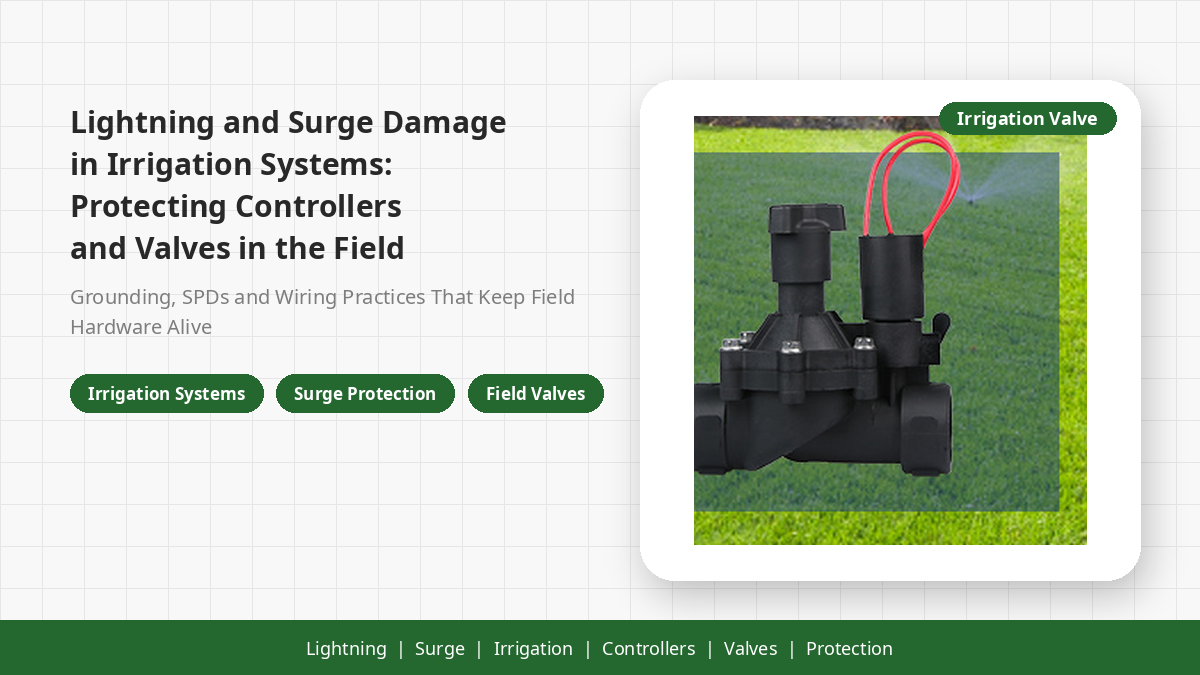
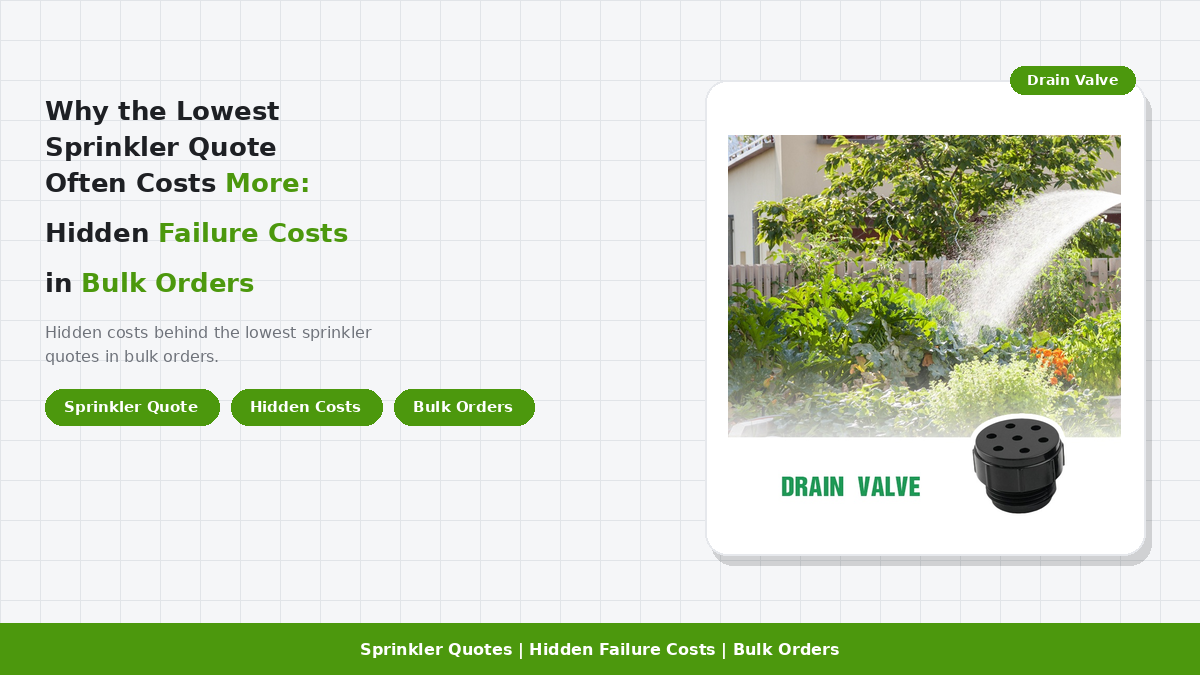
Rainlin RL-EVA75 3/4" solenoid valve — the type of field-end valve whose coil needs surge protection at the coil itself, not just at the controller end. Source: Rainlin RL-EVA75 product page.
Why Exposed Irrigation Sites Take Surge Damage Differently
Most electrical systems sit indoors, in metal conduit, behind service-entrance protection. An irrigation site is the opposite of that — long outdoor cable runs, exposed controllers, valve wiring that loops across acres of open ground— and that physical layout makes the Irrigation System a uniquely vulnerable target for induced surges.
Three features of a typical exposed irrigation site make surge survival harder than the same hardware would experience indoors:
The physical-layout insight: the longer the conductor run that crosses the cabinet boundary, the more surge energy it can pick up — because the magnetic field from a nearby strike couples energy proportional to the loop area enclosed by the conductors. This is why a 500-foot valve wire run is a fundamentally different surge problem than 50 feet, even with the same controller and the same SPD model.
- Long valve cable runs. A 24 VAC station wire that runs several hundred feet across a landscape or agricultural field acts as a long-loop antenna for nearby surges. The longer the loop, the more magnetic flux it picks up from a nearby strike.
- Mixed conductor types entering one cabinet. AC mains, valve common, sensor wires, and sometimes antenna or ethernet all cross the same cabinet boundary. Each conductor type is a separate surge entry path, and each needs its own protective device.
- Isolated field-end equipment. Solenoid valves and soil-moisture sensors are physically isolated from the controller cabinet, so the surge has nowhere to dissipate except through the connected equipment. The coil itself becomes the sacrificial component.
The pattern we see in field tickets: most controller failures blamed on "lightning" are actually induced surges from strikes within a few hundred meters, not direct strikes on the controller. A direct strike on the cabinet is a low-probability event; an induced surge on a long cable run during storm season is the everyday cause.
What Actually Happens When Lightning Strikes an Irrigation Controller
The phrase "the controller took a lightning strike" usually means something more specific. Because a direct strike on the cabinet is rare, what the field technician usually finds is one of three documented failure modes — and each points to a different conductor that needed protection.
- AC mains surge. A surge enters through the 110/230 V supply, jumps the input protection of the controller's power supply, and destroys the power supply section. The display may go dark, the controller may be totally unresponsive, and the internal fuse or MOV may have visibly ruptured.
- Valve-line surge. A surge enters through the 24 VAC station wires, burns out the station-driver ICs, and may take out the solenoid coil in the field at the same time. The display may still work on battery power, but no station will activate when commanded.
- Communication-line surge. A surge enters through ethernet, Wi-Fi antenna coax, or sensor wires, and destroys the communication or sensor-input section of the controller. The display works, stations work locally, but remote access or sensor-based scheduling fails.
The repair priority that follows from this triage: if the failure is AC mains, the controller must be repaired or replaced before the next irrigation cycle; if it is valve-line, the field-end coils must be checked before any station is energized; if it is communication-line, the controller can usually keep running on local programming while the communication SPD is replaced.
The diagnostic shortcut our support team uses: before opening the cabinet, walk the field and look at the solenoid valves. If you find one or more valves with visibly damaged coils (cracked bobbin, melted insulation), the surge came in through the valve wiring. If the valves are fine but the display is dead, it came in through the AC mains. If the valves and display work but remote access is dead, it came in through the communication line.
Three Surge Pathways Most Field Installers Miss
A properly specified surge protection plan covers all five conductor types — but three of them are routinely skipped in field installations, and they are the three most common surge entry paths in our field tickets. Because the most overlooked pathways are the ones nobody remembers to count, the five-conductor checklist below is the one we share with every installer we work with at Rainlin.
- The valve common wire. The valve common is often left unprotected because it is, by definition, shared across all stations. A surge on any one station can ride the common into every station driver simultaneously, which is why an SPD on each station wire alone is insufficient — the common needs its own SPD too.
- The sensor or rain-cup wire. Soil-moisture sensors and rain-cup sensors sit outdoors on their own cable runs and are typically wired directly into the controller's sensor terminals without any protection. A nearby strike induces a surge in the sensor wire and burns the sensor input.
- The Wi-Fi antenna or ethernet cable. Outdoor Wi-Fi antennas and buried ethernet runs are surge entry paths that are easy to forget because the installer thinks of them as "communication" rather than as "another conductor crossing the cabinet boundary."
The five-conductor rule we apply: AC line, AC neutral, AC ground, valve common, and every active station wire each need their own SPD or MOV treatment. Adding sensor and communication lines to the list brings the typical controller's protected-conductor count to seven or eight — far more than most field installations cover.
Grounding Is the Foundation, Not the Solution
Every surge protection discussion starts with grounding, and every surge protection failure we see in the field traces back to inadequate grounding. But grounding is the foundation — not the protective device — because a surge protective device without a low-impedance ground has nowhere to dump the surge current it intercepts.
The grounding rules below are the ones we follow when commissioning an exposed irrigation site:
Most irrigation field failures we investigate have a grounding defect at the root, not an SPD defect. The bonding conductor is too long, the ground rod resistance is too high, the rod has corroded, or the valve common has been bonded at both ends. Identifying which one is the failure mode of the surge protection itself.
- Short, straight bonding conductor. Every centimeter of bonding conductor between the cabinet ground bar and the ground electrode adds impedance. Use a 6 AWG or larger bonding conductor and run it as straight and short as the site allows — no coils, no sharp bends, no daisy-chained ground rods.
- Single-point bonding at the controller. The valve common should be grounded at the controller end of the cable run, not at the valve end. A bonding at both ends creates a ground loop that picks up magnetic surge fields and converts them into loop currents.
- Ground electrode resistance target. The ground electrode system should target 25 ohms or less in most soil conditions, with 10 ohms or less for sites with frequent storm exposure. A single 8-foot ground rod typically meets the 25-ohm target in moist soil but falls short in dry or rocky soil — which is when multiple rods or a ground ring become necessary.
- Bond all metallic components. Metal valve boxes, metallic conduit, and any metal irrigation accessories within reach of the valve wiring should be bonded to the same grounding electrode system, because an unbonded metallic component becomes a floating electrode that picks up induced voltage.
Field warning: if the surge protection devices in your cabinet keep failing after storms, the most likely root cause is not the SPD model — it is the grounding. A higher-rated SPD will still fail if the bonding conductor is too long or the ground electrode resistance is too high.
Choosing Surge Protection Devices by Failure Mode
Surge protective device selection is not a "buy the biggest one" exercise — it is a "match the device class to the failure mode" exercise. Because Type 1 and Type 2 SPDs are tested against different surge waveforms and carry different price tags, picking the right class for the right location is what keeps the protection cost in the field-realistic range.
| SPD type | Test waveform | Typical location | Cost band |
|---|---|---|---|
| Type 1 (per IEC 61643-1) | 10/350 µs impulse | Service entrance, before the meter | Higher (handles direct-strike energy) |
| Type 2 (per IEC 61643-1) | 8/20 µs impulse | Sub-panel, irrigation cabinet AC mains | Mid (handles induced surges) |
| Type 3 | 1.2/50 µs voltage, 8/20 µs current | End-of-circuit, equipment-level | Lower (point-of-use protection) |
| MOV at solenoid coil | Clamping varistor | Across solenoid coil terminals | Lowest (field-end sacrificial protection) |
The protection philosophy we recommend: Type 1 at the service entrance (if the building has one), Type 2 at the irrigation cabinet AC mains, and either Type 3 or dedicated valve-line SPDs on the 24 VAC valve wiring, plus an MOV across the solenoid coil at every isolated valve. This layering matches the device class to the surge waveform at each location.
For sites with frequent direct-strike exposure — golf courses, open agricultural fields with metallic infrastructure, sites on hilltops — the protection stack should add a Type 1 SPD at the service entrance even if it doubles the protection cost, because induced surges in those locations can carry Type-1-class energy on rare storm days.
For the US market, the relevant standard is UL 1449 for SPDs and IEEE C62.41 for the surge environment on low-voltage AC power. For international installations, IEC 61643-1 is the parallel document, and IEC 62305 covers the risk-management framework that ties the protection levels to the site's lightning exposure.
The procurement shortcut: when evaluating surge protection components for an exposed irrigation site, ask the supplier for the SPD's nominal discharge current (In), maximum discharge current (Imax), and voltage protection level (Up). A Type 2 SPD with In of at least 5 kA and Up below 1.5 kV is the typical minimum for irrigation cabinet AC mains — anything below that rating is point-of-use protection, not cabinet-level protection.
Wiring a Solenoid Valve for Surge Survival
The controller cabinet is the easy part of a surge-tolerant design — the harder part is the field-side wiring, where the valve common and station wires run for hundreds of feet across exposed ground. Because the field-side loop area is what couples magnetic surge energy into the system, three wiring rules apply to every valve circuit we install at Rainlin.
- Run common and station wires in the same conduit. The valve common and each station wire should share one conduit so the loop area they enclose is as small as the site allows. A long, separated common-and-station run is a better surge antenna than a tight, paired run.
- Avoid parallel runs with AC mains. Valve wiring that runs parallel to AC mains conductors for more than a few feet picks up inductive coupling from the mains. Cross AC mains at right angles where the run must cross.
- Ground the valve common at the controller end only. Grounding the common at both ends creates a ground loop that converts magnetic surge fields into loop current. Ground once, at the controller end.
For an RL-EVA75 3/4" solenoid valve in an exposed field installation, our typical wiring practice is: shared conduit with the common, AC mains crossing at right angles, MOV across the solenoid coil terminals at the valve, and an SPD on the station wire at the cabinet boundary. The MOV at the coil is the single most common omission — and it is the single most common reason a valve is damaged even when the controller survives.
For sites with frequent storm exposure, we add a third layer: a Type 3 SPD at the field-end splice box. That extra layer handles the residual surge that arrives at the valve after the controller-end SPD has already clamped most of the energy, and it is what makes the difference between a valve that needs replacement every storm season and one that survives multiple seasons without intervention.
Controller Protection: What the IP Rating Does Not Cover
Procurement teams often specify IP65 or IP67 irrigation controllers on the assumption that the enclosure rating protects the electronics against storm damage. Because the IP rating is a weather-ingress story — water jets, dust, brief immersion — it has nothing to do with surge survival, the rating on the cabinet should be chosen for weather and physical protection separately from the surge protection design.
The honest distinction we draw for our customers: choose the IP rating for the weather and dust exposure, and choose the surge protection devices for the lightning exposure — and treat them as two independent decisions in the BOM. A controller in an IP65 cabinet with no SPD on the valve wiring will still fail in the next storm; an IP20 controller in a weather-protected enclosure with a full SPD stack will survive most induced surges.
The cabinet-level surge protection stack for an exposed irrigation controller typically includes a Type 2 SPD on the AC mains, an SPD on the 24 VAC valve common, dedicated SPDs on each active station wire, an SPD or MOV on sensor or rain-cup terminals, and an SPD on ethernet or antenna coax. Each of those is a separate line item on the protection bill of materials, and each is a documented field-ticket data point when it is skipped.
For our exposed-site controller range, the surge protection bill of materials typically adds seven or eight line items beyond the cabinet itself — and when the installer tries to save cost by skipping two or three of them, the field failure rate tracks the skipped items almost one-to-one.
A Field Maintenance Schedule After Lightning Season
Surge protection is not install-and-forget. Because surge protective devices are wear items — every strike they clamp uses up a small portion of their lifetime capacity, a maintenance schedule is what keeps the protection stack functional year over year.
The replacement-cost framing our customers respond to: a scheduled spring SPD replacement costs a small fraction of an unplanned controller replacement after a lightning event. Maintenance is the cheaper path by a wide margin.
- Pre-storm-season inspection (spring). Check every SPD indicator light, replace any SPD showing end-of-life status, verify ground electrode resistance is in the design range, and inspect bonding conductors for corrosion or mechanical damage.
- Post-storm inspection (after any major event). Walk the site, check SPD indicators, inspect the controller for any unusual behavior, and inspect field-end solenoid coils.
- Annual SPD replacement cycle. For sites with frequent exposure, replace all SPDs on a planned cycle — typically every three to five years depending on the device's nominal discharge current rating and the local storm frequency.
- Ground-electrode resistance re-test. Re-measure the ground electrode resistance annually and after any nearby construction that may have disturbed the grounding system.
- Documentation update. Record every replacement, indicator change, and resistance reading in the maintenance log — because the trend in those readings predicts the next failure better than any single reading.
For the sites we support most actively, the pre-storm-season inspection is the single most cost-effective maintenance step. A failed SPD that goes unnoticed through one storm season usually takes a controller with it; a failed SPD caught during a 30-minute inspection is a routine replacement.
Talk to Rainlin about surge-tolerant field installations
If you are evaluating surge-tolerant designs for an exposed irrigation site — or rebuilding after a recent storm — our engineering team can walk you through the conductor-by-conductor protection plan for your specific controller and valve layout.
Frequently Asked Questions
Why are irrigation controllers so often damaged by lightning?
Because irrigation controllers are typically installed outdoors with long cable runs to solenoid valves, exposed AC mains wiring, and antenna or Wi-Fi connections, every cable acts as a surge antenna during a storm. A direct strike is rare; induced surges from nearby strikes are the everyday cause, and they enter through any conductor that crosses the cabinet boundary.
What is the difference between a Type 1 and Type 2 SPD for irrigation?
Type 1 SPDs handle direct lightning currents at the service entrance and are tested with the 10/350 µs waveform, while Type 2 SPDs handle induced surges downstream of the service entrance and are tested with the 8/20 µs waveform per IEC 61643-1. For most irrigation controllers, a Type 2 SPD at the AC mains plus dedicated SPDs on the 24 VAC valve wiring gives the right protection at the right cost.
Does grounding alone protect an irrigation controller from lightning?
No. Grounding provides the path for surge current to dissipate, but without surge protective devices on the conductors, the surge current still flows through the controller electronics before it reaches ground. A proper installation needs both: a low-impedance grounding electrode system AND SPDs on every conductor crossing the cabinet boundary.
How should solenoid valve wiring be routed for surge survival?
Solenoid valve wiring should follow a few field rules: run the valve common and each station wire in the same conduit to minimize the loop area exposed to a magnetic surge field, avoid running valve wires parallel to AC mains for long distances, ground the valve common at the controller end only, and install SPDs on each station wire at the controller cabinet boundary.
Can a solenoid valve itself be damaged by lightning even with controller protection?
Yes. A nearby strike can induce a surge in the field-side valve wire loop even when the controller is protected, and the solenoid coil is a vulnerable target because it presents a high-impedance inductive load to the surge. That is why field-proven installations add an SPD or MOV at the solenoid coil itself, especially for valves that are physically isolated from the controller cabinet.
What IP rating is enough for an irrigation controller cabinet against surge?
IP ratings cover water and dust ingress, not electrical surge. A controller in an IP65 cabinet is well protected against weather but offers no surge protection on its own. Surge survival depends on SPD selection, grounding, and conductor routing inside and outside the cabinet — not on the enclosure rating.
How often should irrigation surge protection be inspected?
A pre-storm-season inspection in spring and a post-storm inspection after any major lightning event is the typical cadence, with the surge protection devices themselves inspected for indicator-light status and replaced when the indicator shows end-of-life. Sites with frequent storm exposure often move to a twice-yearly schedule plus post-event checks.
What standards govern surge protection for irrigation systems?
IEC 61643-1 covers low-voltage surge protective devices, UL 1449 is the US equivalent for SPDs, IEEE C62.41 defines the surge environment on low-voltage AC power, NFPA 780 covers lightning protection system installation, and IEC 62305 covers protection against lightning risk management. Together they form the engineering basis for a surge-tolerant irrigation design.